
Bridal Processional Music Classical: The Complete Guide


Classical bridal processional music refers to instrumental compositions from the Baroque, Classical, and Romantic eras performed as the bride walks down the aisle, spanning works by composers including Pachelbel, Bach, Handel, Vivaldi, and Wagner. In 2026, couples are pairing these timeless pieces with live string quartets, solo cello, and classical crossover arrangements of contemporary songs to create ceremony soundscapes that feel both rooted and personal.
Canon in D by Pachelbel is the most frequently chosen classical processional piece, opening with solo cello and building to full string virtuosity.
Wagner's Bridal Chorus (from his 1850 opera Lohengrin) remains among the most recognized processional songs across generations of weddings.
Vivaldi's Four Seasons has been used at weddings for over 300 years, with Max Richter's 2012 recomposition of Spring 1 gaining traction as a modern alternative in 2026.
Classical ceremony music is typically divided by moment: pre-ceremony, processional, register signing, and recessional, each calling for different tempo and mood.
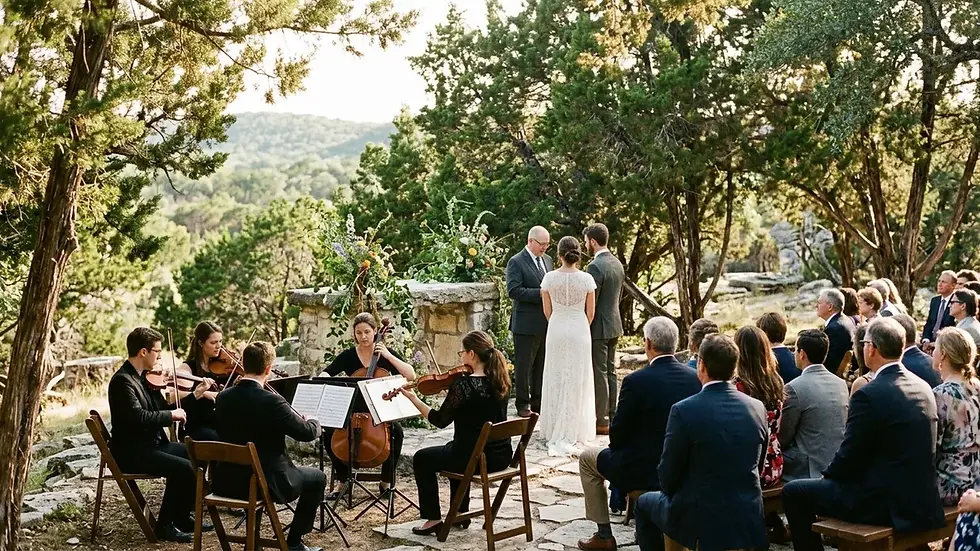
Live string quartet and solo violin with piano are industry-standard performance formats for classical wedding processional music.
In 2026, couples increasingly blend Western classical pieces with classical crossover arrangements of contemporary hits, a trend accelerated by the Bridgerton soundtrack's popularity.
Choosing the right processional piece is one of the most emotionally charged decisions in wedding planning, and it deserves more deliberate thought than most couples give it. The music playing as you walk toward your partner is not background sound. It is the emotional signal that tells every person in the room something significant is about to happen. At Cap City Band, we have performed at hundreds of Texas weddings and worked closely with couples on their ceremony music, and the question we hear most often is: which classical pieces actually work for a live ceremony, and how do you choose between them?
This guide covers the most important classical pieces for every ceremony moment, the practical decision framework that competitors rarely provide (including tempo guidance, venue acoustics, and instrument considerations), and how a live performance transforms these centuries-old compositions into something genuinely memorable. Whether your ceremony is in a stone Hill Country chapel outside Austin or a downtown Houston ballroom, the pieces and principles here apply directly to your planning.
What Song Do Brides Traditionally Walk Down the Aisle To?
Brides traditionally walk down the aisle to one of two pieces: Pachelbel's Canon in D or Wagner's Bridal Chorus, also widely known as "Here Comes the Bride." Canon in D has become the single most commonly chosen classical processional piece at modern weddings, while the Bridal Chorus from Wagner's 1850 opera Lohengrin is described by music historians as perhaps the most famous processional song in the Western tradition. Both pieces remain dominant choices in 2026, though couples increasingly personalize around them.
Pachelbel's Canon in D opens with just a solo cello line, then layers in violin voices progressively, building from quiet intimacy to a full-string blaze by the time the bride reaches the altar. That natural crescendo structure is precisely why it works so well for a processional: the music mirrors the emotional arc of the walk itself. The piece runs roughly five to seven minutes at a natural walking tempo, which suits most aisle lengths without awkward looping.
Wagner's Bridal Chorus carries a different emotional weight. It is bold, ceremonial, and unmistakable from its first measure. Couples who want a grand, declarative entrance tend to gravitate toward it. One note worth knowing: Handel's "Eternal Source of Light Divine," composed in 1713 to mark the birthday of Queen Anne, was the piece played as Meghan Markle walked down the aisle at St George's Chapel in 2018, and it has since seen renewed interest as a refined alternative to the two dominant choices. Specifically for couples who want something rooted in royal tradition but less familiar to guests, it is worth serious consideration.
What Is the Traditional Music for the Wedding Processional?
Traditional wedding processional music is drawn primarily from the Western Baroque and Romantic eras, with Pachelbel's Canon in D, Bach's Air on the G String, Handel's Arrival of the Queen of Sheba, and Wagner's Bridal Chorus forming the core classical canon. These pieces have been performed at weddings for generations because they share specific musical qualities: stately tempo, harmonic warmth, and melodic clarity that carries beautifully across both outdoor and indoor acoustic environments.
Bach's Air on the G String, drawn from Suite No. 3 in D Major, is particularly well suited to intimate ceremonies. The warm cello tones are the defining sound of the piece, and it moves at a measured, dignified pace that gives brides with shorter aisles a composition that does not feel rushed. String quartet arrangements of this piece remain an industry benchmark.
Handel's Arrival of the Queen of Sheba brings a lighter, more festive energy than Canon in D. It was played at the wedding of the Duke and Duchess of Cambridge in 2011, and that moment reintroduced it to a global audience. For couples who want a processional that feels celebratory rather than solemn, this is the strongest classical option in the repertoire.
Less discussed but genuinely useful: Trumpet Voluntary in D Major, correctly attributed to Jeremiah Clarke (commonly misattributed to Purcell), also known as "The Prince of Denmark's March," delivers a ceremonial fanfare quality that suits larger venues with high ceilings. The trumpet timbre cuts through reverb beautifully, making it one of the few classical processional pieces that actually gains impact in a cathedral or ballroom with challenging acoustics.

How Do You Choose the Right Classical Piece for Your Specific Ceremony?
Choosing classical bridal processional music requires matching three variables: aisle length and walk duration, venue acoustic environment, and the emotional tone the couple wants to set. Most online guides list pieces without addressing any of these factors, which is why so many couples default to Canon in D without knowing whether it actually fits their ceremony. A practical decision framework makes the choice far more deliberate and satisfying.
Aisle Length and Tempo Matching
Tempo is the most overlooked factor in processional music selection. A typical bridal walk at a natural, dignified pace covers roughly one foot per second, meaning a 60-foot aisle takes approximately 60 seconds. Canon in D at a live performance tempo runs five to seven minutes, which means it needs no looping for most ceremonies. Bach's Air on the G String runs two to three minutes, making it better suited for shorter aisles or when only a portion of the piece is used. Handel's Arrival of the Queen of Sheba moves faster and works well for bridesmaids' entrance music when a lighter mood is appropriate.
If your aisle is unusually long or your ceremony involves a slow, deliberate processional with multiple pauses, discuss the tempo plan with your musicians in advance. A live ensemble can extend a piece, add a repeat of the A section, or transition seamlessly into a second piece. Recorded music cannot adapt in real time.
Venue Acoustics and Instrument Choice
Venue acoustics should directly influence which instruments you book. Stone churches and cathedral spaces with long reverberation times (often three to five seconds of natural echo) favor organ and brass instruments, which hold tones long enough to be intelligible even with overlap. Widor's Toccata from Organ Symphony No. 5, used by Princess Margaret as her recessional, was specifically chosen for a large ceremonial space where the organ's sustained tones fill the room without muddying.
Outdoor Hill Country venues in Texas, particularly the cedar-and-limestone properties along the 290 corridor, have no natural reverberation. In these settings, a string quartet projects clearly and intimately, and pieces like Vivaldi's Largo from Winter carry beautifully across open air without amplification. For covered outdoor spaces or tented receptions, a single amplified solo violin with piano backing can maintain clarity without overpowering guest conversation during cocktail hour transitions.
Religious vs. Civil Ceremony Context
Some pieces carry specific religious or royal connotations that matter in certain ceremony contexts. Handel's "I Was Glad" (formally attributed to Parry, not Handel) and Bach's "Wachet Auf" (BWV 645) are specifically rooted in Lutheran liturgical tradition, which makes them deeply appropriate for religious ceremonies but potentially mismatched for civil or secular weddings. Couples planning a civil ceremony outdoors should lean toward Pachelbel, Vivaldi, and Handel's Arrival of the Queen of Sheba, all of which carry emotional weight without liturgical associations.
What Are Some Classic Bride Entrance Songs?
Classic bride entrance songs in the classical tradition include Canon in D by Pachelbel, Air on the G String by Bach, Arrival of the Queen of Sheba by Handel, the Bridal Chorus from Wagner's Lohengrin, and Gabriel's Oboe by Ennio Morricone. Each piece carries a distinct emotional character, and the best choice depends on whether the couple wants a grand ceremonial entrance, a tender intimate moment, or something in between.
Gabriel's Oboe deserves particular attention. Composed by Morricone as the main theme for the 1986 film The Mission, also known as "Nella Fantasia" in its vocal version, it has become a genuine wedding processional favorite over the past two decades. The solo oboe line is hauntingly beautiful and immediately emotionally resonant. It works best in mid-sized indoor venues where the instrument's warmth can be heard clearly, and it is a strong choice for couples who want something recognizably classical but distinctly less common than Pachelbel.
For 2026 specifically, Max Richter's recomposition of Vivaldi's Spring 1 from the Four Seasons is emerging as a compelling modern alternative. Richter stripped the original down to its essential harmonic structure and reimagined it with a contemporary minimalist sensibility, making it a bridge between classical tradition and modern aesthetic. Couples drawn to the Bridgerton aesthetic, which brought classical crossover arrangements of pop songs to mainstream attention, often respond well to this piece as a processional choice.
If you want to explore how a live band can present these pieces alongside a full reception setlist, the wedding music planning resources on the Cap City Band blog offer practical context for building a full-event music program from ceremony through last dance.
What Are Some Good Wedding Processional Songs in the Classical Tradition?
Good classical wedding processional songs span from Baroque-era compositions to late Romantic and early 20th-century pieces, with the strongest options including Pachelbel's Canon in D, Bach's Air on the G String, Vivaldi's Four Seasons movements, Handel's Arrival of the Queen of Sheba, and Jeremiah Clarke's Trumpet Voluntary. Each of these pieces has a documented history of use at formal ceremonies, including high-profile royal weddings, which provides social proof of their ceremonial appropriateness.
The following table organizes the most well-regarded options by ceremony moment, composer era, and recommended live format to help you match pieces to your specific event structure.
Piece | Composer / Year | Best Ceremony Moment | Recommended Format | Emotional Character |
Canon in D Major | Pachelbel / c. 1680 | Bridal processional | String quartet | Warm, building, triumphant |
Air on the G String | Bach / c. 1731 | Bridal processional or register signing | Solo cello or string quartet | Tender, dignified, intimate |
Arrival of the Queen of Sheba | Handel / 1749 | Bridal party entrance or processional | Chamber ensemble or piano duet | Festive, bright, celebratory |
Bridal Chorus ("Here Comes the Bride") | Wagner / 1850 | Bridal processional | Organ, piano, or string ensemble | Ceremonial, grand, iconic |
Trumpet Voluntary in D Major | Jeremiah Clarke / 1700 | Processional or recessional | Trumpet with organ | Fanfare, bold, ceremonial |
Gabriel's Oboe | Morricone / 1986 | Bridal processional | Solo oboe or solo violin | Lyrical, emotional, cinematic |
La Réjouissance | Handel / 1749 | Recessional or pre-ceremony | Brass ensemble or full orchestra | Joyful, triumphant, energetic |
Spring 1 (Recomposed) | Richter after Vivaldi / 2012 | Bridal processional | String quartet or solo violin | Modern, minimalist, ethereal |
Widor's Toccata | Widor / 1879 | Recessional | Organ | Triumphant, jubilant, grand |
Eternal Source of Light Divine | Handel / 1713 | Bridal processional | Trumpet with strings | Regal, serene, luminous |

What Is the Difference Between Live and Recorded Classical Processional Music?
Live classical processional music differs fundamentally from recorded music in its ability to adapt in real time to the ceremony's pace, mood, and unexpected moments. A live ensemble can slow the tempo when the bride pauses, extend a section if the procession runs long, or shift dynamics when a flower girl stops to scatter petals. Recorded music plays at a fixed tempo regardless of what is happening in the room, which is why professional wedding planners and venue coordinators increasingly recommend live performance as the standard for ceremony music.
String quartets and chamber ensembles are the most requested live format for classical ceremony music, and for good reason. A skilled quartet playing Canon in D can make the familiar feel transcendent because the performance has the natural imperfections, breath, and presence that a recording lacks. Guests hear something that could not exist anywhere else, at any other moment. That specificity is what separates a memorable ceremony from a beautiful one.
From Cap City Band's experience performing at Texas weddings across Austin, Houston, San Antonio, and Dallas, the ceremonies that generate the most emotional response from guests are almost always the ones with live music rather than recorded tracks. The moment a live musician starts playing and the room shifts from ambient conversation to expectant silence is something no playlist replicates.
For couples planning the full arc of their wedding music from ceremony through reception, our guide to live band entertainment and emcee coordination explains how professional musicians handle the transition between ceremony formality and reception energy under a single booking.
What Should You Know About Classical Crossover Arrangements for 2026 Weddings?
Classical crossover arrangements for wedding ceremonies are contemporary pop, folk, or film songs reimagined for classical instruments such as string quartet, solo cello, or violin with piano accompaniment. In 2026, classical crossover has become one of the most requested categories for bridal processional music, with couples drawn to pieces like a string quartet arrangement of Taylor Swift's Wildest Dreams or a solo cello version of a favorite film theme delivering the emotional depth of classical music without requiring guests to recognize a 300-year-old composition.
The Bridgerton Netflix series accelerated this trend significantly. The show's soundtrack, which featured string quartet arrangements of pop songs including Ariana Grande and Maroon 5 tracks, introduced an entirely new audience to the emotional potential of classical instruments playing familiar melodies. Couples who grew up hearing these songs on streaming services now want that specific sound at their ceremony.
Practical guidance for incorporating crossover arrangements: confirm with your ensemble that they hold the sheet music or arrangement for your chosen piece before the booking is finalized. Not every classical crossover arrangement is widely available, and a live ensemble needs rehearsal time with any unfamiliar piece. For complex contemporary arrangements, plan to confirm this at least eight to twelve weeks before your wedding date.
On the Austin wedding band scene, the breadth of musicians who can bridge classical ceremony sensibility and a high-energy reception is limited. Cap City Band's vocalist Suzanne Van Velson brings a classical foundation rooted in vocal performance studies at Lamar University alongside more than a decade of professional ensemble experience, which means the transition from a carefully curated ceremony to a full reception setlist is handled by musicians who understand both worlds.
What Are the Best Classical Pieces for Each Ceremony Moment?
Classical ceremony music is most effectively organized by the specific moment it serves: pre-ceremony guest seating, bridal party entrance, bridal processional, register signing or reflection, and recessional. Each moment calls for a different tempo, dynamic range, and emotional tone. Treating ceremony music as a single undifferentiated category is the most common planning mistake, and it results in pieces that feel tonally mismatched to the moments they accompany.
Pre-Ceremony and Guest Seating
For the 20 to 30 minutes while guests arrive and find their seats, the music should be warm and ambient without demanding attention. Bach's Wachet Auf (BWV 645) is specifically recommended for this purpose when an organist is available, as its steady chorale character creates a sense of arrival without anticipation. Mozart's Divertimentos for string quartet work equally well for this moment because, as their chamber music character suggests, their simple, conversational tunes provide an elegant sonic backdrop without competing with guest conversation.
Bridal Party Entrance
Handel's Arrival of the Queen of Sheba is the strongest option for the bridal party entrance. Its light, brisk tempo creates natural energy and forward movement without the solemnity of the bridal processional pieces. The bright, festive character signals to guests that the ceremony is beginning without yet reaching its emotional peak. Air on the G String works here too, particularly for smaller weddings where a more intimate tone suits the venue.
Bridal Processional
This is the moment that defines the ceremony's musical identity. Canon in D, the Bridal Chorus, Air on the G String, or Gabriel's Oboe are the strongest choices, each for different reasons outlined in the sections above. The single rule: the piece must have a natural dynamic shape that builds slightly across its duration, matching the emotional crescendo of the walk itself. A flat, unchanging piece feels static for a two-to-three minute walk.
Register Signing or Reflection
The period during which the couple signs the register or shares a quiet moment mid-ceremony benefits from a piece that supports reflection without demanding attention. Meditation from Massenet's opera Thaïs, performed by solo violin with piano accompaniment, is an industry benchmark for this moment. The piece is lyrical and emotionally warm without the grandeur of a processional piece. Handel's Largo, sometimes performed in arrangements from his opera Xerxes, serves a similar function.
Recessional
Recessional music should be jubilant, fast, and unmistakably triumphant. Widor's Toccata from Organ Symphony No. 5, used by Princess Margaret at her wedding, is the definitive recessional for a large venue with an organ. Crown Imperial: A Coronation March by William Walton served as the recessional for the Duke and Duchess of Cambridge in 2011, and its orchestral majesty translates powerfully for formal, large-scale ceremonies. For smaller or outdoor ceremonies, Handel's La Réjouissance, composed in 1749, delivers the same joyful energy through a brass and string arrangement. The goal for the recessional is to send the couple out of the ceremony space on a wave of sound that feels like the room itself is celebrating.
Coordinating these musical transitions across an entire ceremony is precisely what separates a well-planned event from one that feels loosely assembled. For more on how professional entertainment teams handle transitions across a full wedding day, the Austin wedding bands resource section covers both ceremony and reception planning in practical detail.
Frequently Asked Questions About Classical Bridal Processional Music
What is the most popular classical piece for a wedding processional in 2026?
Canon in D Major by Pachelbel remains the most frequently chosen classical bridal processional piece in 2026, recognized for its building structure that opens with solo cello and crescendos to full strings. It runs five to seven minutes at a natural walking tempo, which suits most ceremony aisle lengths without needing to loop. Wagner's Bridal Chorus from his 1850 opera Lohengrin is the second most recognized choice, favored for its bold, ceremonial character.
Do I need to pay licensing fees for classical music performed at my wedding?
In most cases, no. The compositions themselves, including works by Pachelbel, Bach, Handel, Vivaldi, and Wagner, are in the public domain because they were written centuries before modern copyright law. However, a specific recording of those compositions may be protected by sound recording copyright if you are playing a commercial CD or streaming track. When a live musician performs these pieces, the copyright situation is different: the performance is original and not governed by sound recording law. Your venue may hold a blanket performing rights license through organizations like ASCAP or BMI, but for live performances of public domain compositions, this is rarely a concern in practice. Confirm the specifics with your venue coordinator when you finalize your entertainment contracts.
What is the difference between a string quartet and a chamber ensemble for ceremony music?
A string quartet consists of two violins, one viola, and one cello, and it is the most versatile and widely available live format for classical wedding ceremony music. A chamber ensemble is a broader category that can include additional instruments such as flute, oboe, harpsichord, or piano, enabling a wider range of tonal color and repertoire. For most ceremonies, a string quartet covers the essential classical processional repertoire fully. A chamber ensemble makes sense when the couple wants specific pieces, such as Handel's Arrival of the Queen of Sheba with a harpsichord line, that benefit from additional instrumental voices.
How long in advance should I book a live musician or ensemble for my wedding ceremony?
Professional string quartets and chamber ensembles in Austin, Texas and across major Texas markets typically book peak-season ceremony dates, specifically spring weekends in April through June and fall weekends in September through November, between twelve and eighteen months in advance. For a specific date, begin outreach at least a year out if your wedding falls in a peak month. Off-peak January, February, July, and August dates carry more availability, but quality ensembles still fill several months ahead of time.
Can a live wedding band handle classical ceremony music and reception entertainment under one booking?
Yes, and for many couples this is the most practical approach. A full-service live wedding band can cover classical ceremony music, coordinate cocktail hour background pieces, and then transition into a high-energy reception set under a single contract. Cap City Band structures its wedding entertainment as a full-event experience, with the musical range to move from a Pachelbel processional to a dance-floor reception without requiring the couple to manage separate vendor relationships. Request a quote at capcityband.com to discuss how ceremony and reception coverage works under a single booking agreement.
What classical pieces work for multicultural or non-Western wedding ceremonies?
Most published classical wedding music guides focus exclusively on Western European Baroque and Romantic repertoire, which leaves couples planning multicultural ceremonies with limited guidance. Indian classical traditions, specifically Carnatic and Hindustani instrumental pieces, offer processional-appropriate compositions that can be performed by a sitar, sarod, or flute soloist. Japanese koto music and Latin American classical guitar works by composers like Agustin Barrios Mangore also translate beautifully into processional contexts. If your ceremony blends cultural traditions, discuss specific pieces with a musician who specializes in that tradition rather than defaulting to the Western canon.
Which classical recessional piece creates the most joyful exit?
Widor's Toccata from Organ Symphony No. 5 creates the most jubilant and unmistakably triumphant recessional for ceremonies in large venues with an organ. For outdoor or smaller ceremonies, Handel's La Réjouissance (composed 1749) delivers equivalent festive energy through a string or brass arrangement. The Arrival of the Queen of Sheba also works as a recessional when a lighter, faster energy is preferred over grand ceremonial sweep. Crown Imperial by William Walton, used at the wedding of the Duke and Duchess of Cambridge in 2011, suits large formal ceremonies where a full orchestral sound is available.
How do I brief a live ensemble on tempo for my specific processional?
Walk through your aisle before the wedding, measure the approximate length, and time how long your processional walk takes at a comfortable pace. Share that duration with your musician or ensemble, along with the specific piece you have chosen. A professional ensemble can adjust their tempo interpretation to match your walk duration, add a repeat of the opening section if needed, or plan a clean transition to a second piece if the aisle is unusually long. This briefing conversation should happen at least four to six weeks before the ceremony, not the week of the wedding.
How Do You Build a Complete Classical Ceremony Music Plan?
Building a complete classical ceremony music plan means selecting a different piece for each distinct ceremony moment rather than choosing one processional and leaving the rest to chance. Professional wedding planners and venue coordinators consistently identify ceremony music as one of the most underplanned elements, and the gap between a well-curated ceremony soundtrack and an afterthought is immediately audible to every person in the room.
Start with the processional. That decision anchors the emotional tone for everything else. Once you have your processional piece, choose your recessional to create contrast: if the processional is tender and intimate (Air on the G String, Gabriel's Oboe), the recessional should be jubilant and fast (Widor's Toccata, La Réjouissance). If the processional is already bold and ceremonial (Bridal Chorus, Crown Imperial), the recessional can maintain that energy with a different piece in the same spirit.
Next, fill the pre-ceremony and register-signing moments. For pre-ceremony, 20 to 30 minutes of ambient, warm string music serves guests without demanding attention. For register signing, a lyrical solo piece like Meditation from Thaïs creates a quiet, reflective pause that gives the ceremony room to breathe.
Finally, confirm with your live ensemble that they hold arrangements for all chosen pieces and have adequate rehearsal time before the event. For venues along Austin's 290 Hill Country corridor or at outdoor Texas properties, specifically confirm whether amplification will be used and how that changes the ensemble's instrument balance. A string quartet playing unamplified in a 200-person outdoor space sounds different from the same quartet in a cathedral nave, and a good ensemble will adjust accordingly.
If you are also planning the reception music and want a single entertainment team to handle both ceremony and dancing, the Texas wedding bands planning section covers how to structure that conversation with prospective entertainment providers across Austin, Houston, San Antonio, and Dallas.
Final Thoughts on Classical Bridal Processional Music
Classical bridal processional music has been at the center of wedding ceremonies for more than three centuries because these compositions were built to carry emotional weight in formal settings. Canon in D, the Bridal Chorus, Bach's Air on the G String, Handel's Arrival of the Queen of Sheba, and a growing list of classical crossover pieces give couples in 2026 a richer palette than any previous generation has had access to. The key is choosing deliberately: matching tempo to aisle length, matching instrument to venue acoustics, and matching emotional tone to the moment in the ceremony.
Live performance remains the gold standard for these pieces. A string quartet can respond to the room in real time. A live ensemble playing Canon in D on a September evening at a cedar-and-limestone Hill Country venue outside Austin creates a moment that exists only once, for the people in that specific room, and no recording can replicate that. If your ceremony and reception are happening in Texas, Cap City Band is worth a conversation about how live music can serve both moments under a single booking.

If your ceremony is in Austin, Houston, San Antonio, or Dallas and you want live music from the processional through the last dance handled by a single professional team, start the conversation with Cap City Band. Every booking begins with a discussion about your event, your venue, and the specific pieces and setlist moments that matter most to you. Request a quote at capcityband.com to find out what your wedding ceremony could sound like with live musicians who understand both the classical tradition and the Texas market.
Written by Suzanne Davila, Owner/Performer at Cap City Band


Comments