
Most Popular Bridal Entrance Songs, Explained

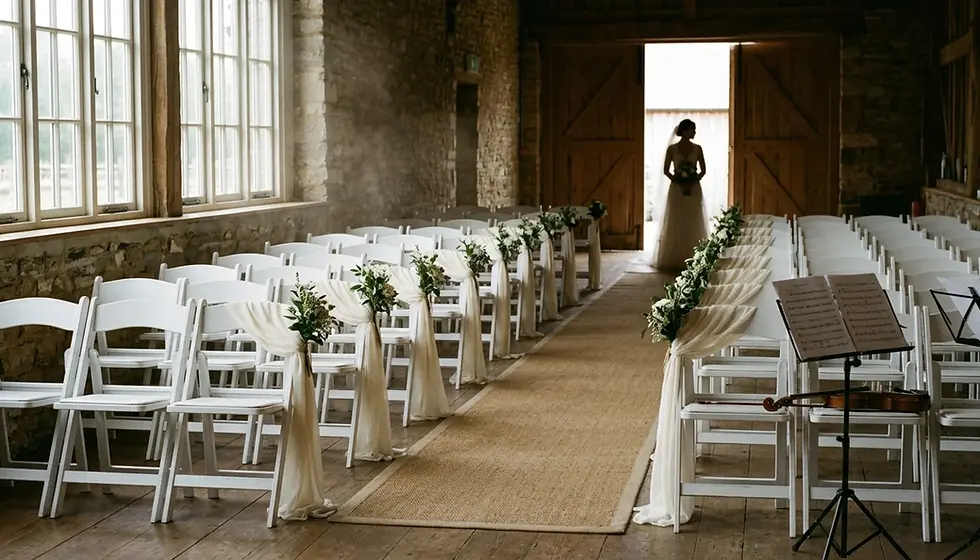
The most popular bridal entrance songs in 2026 split into two camps: timeless instrumentals like Pachelbel's Canon in D Major, and modern ballads like Christina Perri's A Thousand Years. Both work because they build slowly, peak at the right moment, and give a live musician room to follow the bride's actual walking pace instead of a fixed track.
Canon in D Major and A Thousand Years remain the two most requested bridal entrance songs across wedding planning platforms in 2026, according to multiple industry song-list aggregators.
Most ceremony processionals need a song edited or arranged to run about 90 seconds to 2.5 minutes, shorter than the full commercial track.
Couples now spend an average of $35,000 on their wedding as of 2026, with venues alone claiming 24-40% of that budget, per Grand View Research and The Knot Worldwide's 2026 Real Weddings Study.
Live musicians can adjust tempo in real time to match the bride's walking speed, something a fixed recording cannot do.
Song licensing through ASCAP, BMI, or SESAC matters more than most couples realize when a band performs copyrighted music at a public or recorded ceremony.
Genre-based picks, from soul and R&B to country and indie, are gaining ground over strictly classical or top-40 processionals.
Choosing a bridal entrance song is one of the few wedding decisions that gets more attention than almost anything else on the ceremony timeline, and for good reason. It's the moment every guest turns around and the moment most couples remember years later. In 2026, with roughly 2.1 million weddings happening annually in the U.S. and nearly 71% of them now stretched across two to three days of events, according to recent wedding industry data, the entrance song has to do a lot of emotional work in a very short window.
At Cap City Band, we've performed ceremony processionals across Austin, Texas, and beyond, and the question we hear most from couples isn't just "what song should I pick." It's "how do I make sure the band nails the timing." That distinction matters. A recorded track plays at one speed regardless of whether the bride pauses to hug her father or the flower girl stalls halfway down the aisle. A live band adjusts. This guide breaks down the songs couples actually request most, organized by mood and genre, along with the practical details, like licensing, arranging, and timing, that most bridal entrance song lists skip entirely.
What Song Do Most Brides Walk Down the Aisle To?
Most brides in 2026 walk down the aisle to either an instrumental classical piece, Canon in D Major by Johann Pachelbel being the most cited example, or a modern acoustic ballad such as A Thousand Years by Christina Perri. Both appear repeatedly across wedding entrance song aggregators as the two most requested options for the bridal walk.
Canon in D has held its position for decades because of its structure. It builds gradually through repeating chord progressions, which gives a live string quartet, pianist, or full band room to extend or shorten the piece depending on aisle length. A Thousand Years, originally written for the Twilight film series, has become a modern standard for the same structural reason: it starts soft, swells at the chorus, and works whether the aisle is 20 feet or 80 feet long.
Other frequently requested picks in this category include Thinking Out Loud by Ed Sheeran and Can't Help Falling in Love by Elvis Presley, both of which show up across nearly every major wedding song resource. Couples planning an Austin ceremony at an outdoor Hill Country venue often lean toward the acoustic guitar arrangement of these songs specifically because string instruments carry well outdoors without heavy amplification.
What Is the Most Popular Wedding Entrance Song Overall?
The most popular wedding entrance song overall, when you combine bridal processional and wedding party entrance data, is Canon in D Major, cited as a top pick across nearly every major bridal song resource including Hitched and Encore Musicians. Its popularity stems from near-universal recognition and adaptability across string quartet, piano, or full-band arrangements.
For the bride's specific entrance, as opposed to the wedding party's, A Thousand Years edges ahead in modern search data. It's requested specifically for the bride's walk rather than earlier in the processional, largely because the lyrics reference a singular romantic commitment rather than a general celebration.
Notably, couples are increasingly splitting their processional into segments: one song for the wedding party, a tempo change or full song swap for the bride. This is where a live band creates a meaningfully better experience than a single pre-recorded playlist. A band can transition from an upbeat processional for bridesmaids into a slower, more intimate arrangement the moment the bride appears, without an awkward pause or a DJ scrambling to find the next track. That kind of live transition is something we build directly into our ceremony sets at Cap City Band, adjusting the handoff based on how the couple wants the moment to land.

Which Song Is Best for the Bride's Entry Specifically?
The best song for a bride's entry is one with a clear, gradual build, a runtime that can be trimmed to roughly 90 seconds to 2.5 minutes, and a tempo slow enough to match a deliberate walking pace. Songs like Make You Feel My Love by Adele and Songbird, popularized by both Eva Cassidy and Fleetwood Mac, meet all three criteria and appear consistently across top bridal entrance song lists.
What separates a "good" bridal entrance song from a merely popular one is how well it survives editing. Full commercial tracks typically run 3.5 to 4.5 minutes. Most aisles take under a minute to walk, even at a slow pace, which means the song needs a natural cut point, usually right after the first chorus, that doesn't feel jarring.
Instrumental arrangements solve this problem more easily than vocal tracks. A pianist or guitarist can simply stop at a chord resolution. Vocal tracks are trickier: cutting off Wonderful Tonight by Eric Clapton mid-verse sounds unfinished, while cutting it after the first chorus sounds intentional. This is exactly the kind of arranging work a professional band handles as part of setlist planning, something worth asking about directly when you're vetting ceremony musicians.
What Are the Top Songs for a Bridal Entrance?
The top bridal entrance songs as of 2026 span both classical and contemporary catalogs, with Canon in D Major, A Thousand Years, and Thinking Out Loud consistently ranking as the three most requested tracks across wedding planning resources. Below is a broader list organized by why each song works for the walk down the aisle.
Song | Artist | Best For | Mood |
Canon in D Major | Johann Pachelbel | Traditional or formal ceremonies | Classical, timeless |
A Thousand Years | Christina Perri | Modern, emotional ceremonies | Romantic, cinematic |
Thinking Out Loud | Ed Sheeran | Couples who want a familiar radio hit | Warm, contemporary |
Can't Help Falling in Love | Elvis Presley | Classic, slow-paced walks | Vintage romantic |
Make You Feel My Love | Adele | Emotional, tear-jerker moments | Deep, ballad |
Marry Me | Train | Couples who want an on-theme lyric | Direct, sincere |
Beautiful in White | Shane Filan | Modern emotional entrances | Soft, contemporary |
At Last | Etta James | Post-ceremony or vintage-themed walks | Soulful, classic |
Notice the mix: classical (Canon in D), 2010s pop-ballad (A Thousand Years, Thinking Out Loud), and older standards (Etta James, Elvis). Couples increasingly choose across categories rather than sticking to one era, which is part of why live band arrangements have become more valuable than a static instrumental-only playlist.
What Are the Top 3 Wedding Songs for Ceremonies?
The top three wedding entrance songs based on repeated appearances across bridal song resources are Canon in D Major, A Thousand Years, and Thinking Out Loud. These three consistently top lists across multiple wedding industry resources, making them the safest, most broadly appealing default choices for couples who want a proven option.
That said, "most popular" doesn't automatically mean "right for your ceremony." Canon in D signals formality; it's the right call for a cathedral-style venue or a black-tie evening wedding. A Thousand Years leans cinematic and works well for outdoor or garden ceremonies where couples want an emotional swell as the bride appears. Thinking Out Loud is the most flexible of the three: familiar enough that guests recognize it instantly, but modern enough not to feel dated.
If none of the top three fit your ceremony's tone, don't force it. A soul-leaning couple might prefer a stripped-down arrangement of Three Times a Lady by the Commodores. A couple who met on a beach vacation might want Over the Rainbow/What a Wonderful World by Israel Kamakawiwo'ole. The point of a "top three" list isn't to limit your options. It's to give you a benchmark for what already works, so you can decide whether to follow the trend or go your own direction.
What Upbeat Songs Work for a Post-Ceremony or Reception Entrance?
Upbeat post-ceremony and reception entrance songs are typically faster-tempo tracks meant to energize guests immediately after the vows, distinct from the slower processional music used for the bridal walk itself. Here Comes the Sun by The Beatles and I'm Yours by Jason Mraz both appear frequently in this category because they carry enough tempo to shift the room's energy without feeling jarring after an emotional ceremony.
The transition from processional to recessional is where a live band earns its keep. A recorded playlist has to fade one track and cue another, often with a few seconds of dead air. A band can carry the energy shift in real time, building from the final chords of the ceremony song straight into an upbeat recessional without a gap. This is a specific service we handle at Cap City Band when we're brought in for both ceremony and reception, and it's one of the clearest arguments for hiring one act to cover the full event instead of splitting ceremony music and reception entertainment between two separate vendors.
All You Need Is Love by The Beatles also shows up on multiple lists as a shorter, joyful option, useful if you want energy without a long instrumental build. For couples planning a reception with live band karaoke later in the night, an upbeat recessional song sets the tone early for an interactive, high-energy evening.

How Do Genre Preferences Change the Bridal Entrance Song List?
Genre preference significantly changes which bridal entrance songs make sense, since a country-leaning couple's ideal processional sounds nothing like a soul or R&B couple's pick, even though both fall under "popular bridal entrance songs." Matching genre to the couple's actual music taste, rather than defaulting to whatever tops a generic list, produces a more authentic ceremony moment.
Country couples often gravitate toward acoustic, stripped-down arrangements of contemporary country ballads rather than the classical or pop-ballad defaults. Soul and R&B-leaning couples frequently choose warmer, vocal-driven picks like At Last by Etta James or a slowed arrangement of Three Times a Lady. Indie-leaning couples tend toward acoustic, less orchestrated versions of contemporary tracks, sometimes requesting a single guitar or piano rather than a full band arrangement for the walk itself.
This is precisely where Cap City Band's vocalist lineup becomes a genuine advantage rather than a marketing line. Forté Appling brings soulful, vocal-acrobatic range built over more than a decade in the Austin music scene since 2011, including stage time opening for acts like Sublime and Bowling For Soup. Suzanne Van Velson trained in vocal performance at Lamar University and has performed with Texas acts including Rotel and the Hot Tomatoes and Memphis Train Revue, giving her range across soul, pop, and classic rock arrangements. Matt Raines brings a jazz and honky-tonk background from cruise ship and Texas venue performances, useful for couples who want a warmer, more organic arrangement than a straight pop cover. Three distinct vocal styles means a genre pivot for the ceremony doesn't require a different band, just a different arrangement from the same trusted act.
How Do You License a Bridal Entrance Song Legally?
Licensing a bridal entrance song legally means securing performance rights through organizations like ASCAP, BMI, or SESAC whenever copyrighted music is performed publicly or included in a recorded video that will be shared or sold. Most venues already carry a blanket performance license covering live music, but couples working with independent musicians or planning to distribute ceremony video commercially should confirm this directly.
Here's what most bridal entrance song articles skip entirely: the difference between playing a song at a private ceremony versus using it in wedding videography that gets posted online or sold to the couple. Playing a cover live at your ceremony is typically covered under the venue's or performer's blanket license. But syncing a copyrighted recording into a wedding video for public distribution, on a videographer's demo reel, or a couple's social media, requires a separate sync license, which most couples never think to ask about.
Professional bands that regularly perform ceremonies, including Cap City Band, are generally aware of these distinctions and can advise which songs are simplest to clear for both live performance and any accompanying video. If your videographer plans to use the ceremony audio in a highlight reel, raise the licensing question with both your band and your videographer before the wedding, not after.
How Do You Adapt a Radio Hit to Ceremony Length Without an Arranger?
Adapting a full-length radio hit to ceremony length means cutting the track down to roughly 90 seconds to 2.5 minutes, since most bridal walks last well under a minute even at a deliberately slow pace and most songs still need a clean instrumental buildup before the bride appears. The simplest approach without hiring a professional arranger is to identify a natural resolution point, typically right after the first chorus, and fade or cut there.
For a DJ-based ceremony, this usually means editing an MP3 in advance using free audio editing software and marking a clean cut point. For a live band, the process is easier and more flexible: the musicians can simply play the intro and verse, hold or vamp on a chord progression until the bride reaches the altar, then resolve into the chorus regardless of exact timing. This is one of the most underrated advantages of hiring live musicians over a fixed playlist, since a band never has to guess exactly how long the walk will take.
If you're set on a song that doesn't have an obvious cut point, ask your band whether they can build a custom arrangement rather than trying to force a radio edit. A four-minute pop song rarely translates cleanly into a 90-second processional without some rearranging, and a band experienced in ceremony music will flag that problem before your wedding day rather than during the rehearsal.
How Should You Coordinate the Entrance Moment With Music, Timing, and Lighting?
Coordinating the bridal entrance moment means syncing the music's emotional build with the physical timing of the walk itself, plus any lighting or visual cues like doors opening or a spotlight change, so the song's peak lands close to when the bride reaches the altar rather than fading out mid-walk. This coordination is almost entirely missing from most bridal entrance song lists, which focus purely on song selection and ignore execution.
Start with your aisle length and walking pace. A 40-foot aisle at a slow, deliberate pace typically takes 30 to 45 seconds. If your chosen song has a big emotional swell at the 60-second mark, either the bride needs to slow down further or the song needs a shorter intro edited in. Second, think about visual cues: if doors open on a cue, coordinate that moment with a specific musical beat, not just "whenever the song starts." Third, and this is where live performance outperforms a fixed track, a live musician watching the bride can adjust timing on the fly if she pauses for a photo moment or waits for a cue from the officiant. A recorded track can't see the room. This is a routine part of ceremony coordination at Cap City Band: we walk through timing with the couple and, where possible, the day-of coordinator or venue staff, so nobody is guessing on the day of the wedding.
What Should Hearing-Impaired or Sensitive Guests Consider in Song Choice?
For ceremonies with hearing-impaired or sensitive guests, choosing bridal entrance songs with clear, unhurried lyrics and a moderate tempo, rather than dense instrumentation or rapid vocal runs, makes the moment more accessible. Songs like Can't Help Falling in Love or Songbird work well here because the melody is simple and the lyrical pacing is unhurried, unlike more vocally complex arrangements.
This consideration is almost entirely absent from mainstream bridal entrance song guides, but it matters for real ceremonies. If you have guests who rely on lip-reading or hearing aids, a slower, less instrumentally busy arrangement, ideally performed live rather than through a PA system with heavy reverb, is easier to follow. Live musicians can also adjust volume and clarity in real time based on the venue's acoustics, something a fixed playback system can't do.
If accessibility is a priority for your ceremony, mention it directly when you brief your band or DJ. A simple request, like favoring a solo vocalist over a full ensemble for the entrance song, or keeping amplification lower during the vows themselves, is easy for an experienced act to accommodate once they know it matters to you.
How Do the Most Popular Bridal Entrance Songs Compare by Mood and Era?
The most popular bridal entrance songs break into three broad categories: classical instrumentals, 2010s-era pop ballads, and vintage soul or standards, each suited to a different ceremony tone. Classical picks like Canon in D signal formality; pop ballads like A Thousand Years and Thinking Out Loud suit modern, emotional ceremonies; vintage soul picks like At Last suit couples wanting a warmer, retro feel.
Category | Example Songs | Ceremony Tone |
Classical/Instrumental | Canon in D Major | Formal, traditional |
2010s Pop Ballad | A Thousand Years, Thinking Out Loud, Lover | Modern, emotional |
Vintage Soul/Standard | At Last, Three Times a Lady | Retro, warm |
Folk/Acoustic | You Are the Best Thing, I'm Yours | Relaxed, outdoor |
Cinematic/Emotional | Make You Feel My Love, Wonderful Tonight | Intimate, tear-jerker |
As of 2026, industry data from Grand View Research shows the U.S. wedding services market is projected to reach roughly $95.35 billion by 2030, growing even as marriage rates hold flat, largely because per-wedding spending keeps rising. Part of that rising spend is going toward more customized, less generic ceremony music, exactly the trend behind couples mixing categories instead of picking a single "top" song off a list.
How Do You Actually Choose the Right Bridal Entrance Song for Your Ceremony?
Choosing the right bridal entrance song starts with matching the song's tempo and mood to your ceremony's formality level, then confirming with your musicians whether the piece needs trimming or rearranging for aisle length. Skipping this second step is the most common mistake couples make, since a beautiful song that runs too long or cuts off awkwardly undercuts the moment it's supposed to elevate.
A practical checklist for choosing:
Decide on formality first: classical or modern acoustic for formal ceremonies, upbeat or genre-specific for casual ones.
Time your actual aisle walk during a rehearsal, then compare that to the song's natural build points.
Ask your musicians whether the song needs a custom arrangement or can be trimmed cleanly.
Confirm licensing if your videographer plans to use the audio in shareable wedding content.
Brief your band on any accessibility needs, tempo preferences, or genre pivots at least a few weeks before the wedding, not the day of rehearsal.
Common mistakes worth avoiding: picking a song purely because it's popular rather than because it fits your ceremony's tone, assuming a DJ playlist can adjust in real time the way a live band can, and forgetting to communicate aisle length and pacing preferences until the wedding day itself. Couples planning ceremonies in Austin, Houston, San Antonio, or Dallas should also factor in venue acoustics: an outdoor Hill Country ceremony carries sound differently than an indoor ballroom, which affects whether a solo guitarist or a fuller band arrangement works better.
Frequently Asked Questions
What song do most brides walk down the aisle to?
Most brides in 2026 walk to either Canon in D Major by Johann Pachelbel or A Thousand Years by Christina Perri, the two most frequently cited bridal entrance songs across wedding planning resources. Both offer a gradual musical build that works whether the aisle is short or long.
What is the most popular wedding entrance song?
Canon in D Major ranks as the most popular overall wedding entrance song when combining wedding party and bridal processional data, appearing on nearly every major bridal song list. For the bride's specific walk, A Thousand Years is the more commonly requested modern alternative.
Which song is best for a bride's entry?
The best songs for a bride's entry have a clear emotional build and a runtime that trims cleanly to about 90 seconds to 2.5 minutes. Make You Feel My Love by Adele and Songbird by Fleetwood Mac both meet these criteria and appear consistently on top bridal entrance lists.
What are the top 3 wedding songs for a ceremony?
The top three wedding ceremony songs, based on repeated appearances across multiple bridal song resources, are Canon in D Major, A Thousand Years, and Thinking Out Loud by Ed Sheeran. These serve as a reliable benchmark, though couples increasingly personalize beyond this list based on genre preference.
Can a live band play any bridal entrance song, or are some songs off limits?
A live band can generally cover most requested bridal entrance songs, though some highly produced modern tracks with electronic elements are harder to translate live than acoustic ballads or classical pieces. Ask your band directly during setlist planning whether your specific song choice fits their instrumentation.
Do you need a different song for the ceremony versus the reception entrance?
Yes, most couples use a slower, emotional song for the bridal processional and a faster, upbeat track for the post-ceremony recessional or reception entrance. Songs like Here Comes the Sun or I'm Yours work well for the higher-energy transition after the vows.
How far in advance should you finalize your bridal entrance song with your band?
Most bands, including Cap City Band, recommend finalizing ceremony song selections at least four to six weeks before the wedding to allow time for arrangement, rehearsal, and any custom edits. Waiting until the week of the wedding limits your options if a song needs significant rearranging.
Is it better to use a live band or a DJ for the bridal entrance song?
A live band offers real-time tempo flexibility that a DJ's fixed track cannot match, which matters most during the unpredictable pacing of an actual bridal walk. For very small or budget-conscious ceremonies, a DJ can still work well, but couples wanting a fully live, responsive ceremony often prefer a band for this reason.
Conclusion: Picking a Bridal Entrance Song That Actually Fits Your Wedding
The most popular bridal entrance songs, from Canon in D Major to A Thousand Years, earn their reputation because they build gradually and adapt to nearly any aisle length or ceremony style. But popularity shouldn't be the only filter. The right choice matches your ceremony's formality, your genre preference, and, just as important, whoever is performing it can adjust the arrangement in real time rather than locking you into a fixed track.
As wedding budgets keep climbing toward the $35,000 average reported for 2026, couples are investing more attention in getting these small, high-visibility moments right. A bridal entrance song is one of the cheapest details to get right and one of the most noticeable to get wrong. Work with musicians who ask about your aisle length, your videographer's needs, and your guests before your wedding week, not during it.

If you're still deciding how your ceremony music should sound, Cap City Band handles bridal processionals across Austin, Houston, San Antonio, and Dallas, and every ceremony set starts with a conversation about your aisle, your genre, and the exact moment you want the room to feel it. Get started with Cap City Band to talk through your ceremony setlist.
Written by Suzanne Davila, Owner/Performer at Cap City Band
Content powered by inkSTR.co


Comments