
Special Dances At Weddings: Complete Order & Song Guide

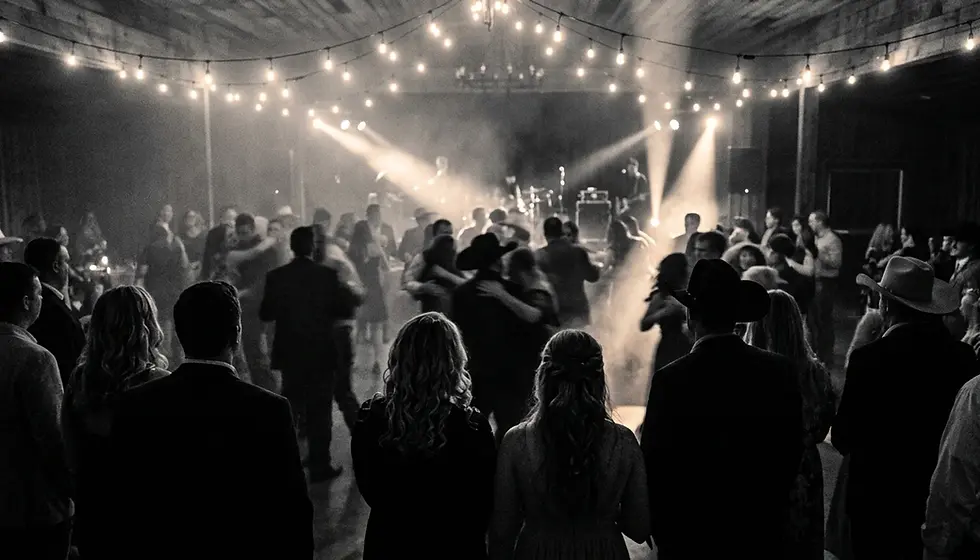
Special dances at weddings are the choreographed or spotlighted moments in a reception, such as the first dance, parent dances, and group traditions like the money dance or anniversary dance, that a couple sets apart from open dancing to honor specific relationships or cultural customs. There is no single mandatory order; the sequence depends on whether you book a live band or a DJ, how many guests you're hosting, and which family traditions matter most to you.
Key Takeaways
Texas weddings averaged 121 to 131 guests in 2026, according to The Wedding Report, a guest count that directly affects how many special dances a reception timeline can comfortably hold.
The average Texas wedding cost $31,577 in 2026, while the median was $17,647, according to The Wedding Report, showing a market with both premium and budget-conscious couples.
Band-led receptions typically place parent dances later in the evening, after the first course and toasts, while DJ-led timelines often front-load them right after the grand entrance.
Industry data from Lupa Entertainment shows roughly 18 percent of couples now choose a hybrid band-and-DJ format, a figure that climbs to about 40 percent for weddings over 200 guests.
Cultural traditions such as the hora, the money dance, and Greek circle dances each have distinct steps, music, and etiquette; treating them as interchangeable "ethnic dance" filler is one of the most common planning mistakes.
Live bands with multiple lead vocalists can shift key, tempo, and arrangement in real time during a special dance, something a fixed DJ playlist cannot replicate mid-song.
If you're staring down a reception timeline template and wondering which dances actually matter for your wedding, you're not alone. Most couples planning an Austin-area wedding in 2026 tell us the same thing: they want the first dance, maybe a parent dance or two, and something for the guests who are dying to get on the floor, but they don't want six formal dances stretching cocktail hour into a slow crawl toward dinner.
At Cap City Band, we've played hundreds of Austin, Dallas, San Antonio, and Houston receptions, and the questions couples ask us before booking follow a predictable pattern. They want to know what order things go in, how long each dance should run, and what happens when family situations don't fit the traditional father-daughter, mother-son mold. This guide covers the full order of special dances at weddings, gives you a practical decision framework for blended families, and includes song guidance organized by relationship type so you're not scrolling five different articles to build one setlist.
What Is the Standard Order of Special Dances at a Wedding?
The standard order of special dances at a wedding typically follows the grand entrance, the first dance, one or two parent dances, dinner, toasts, and then optional group traditions before open dancing begins. DJ-led receptions tend to front-load these moments right after the entrance, while band-led events often spread the dances out to keep energy building instead of peaking too early. The right sequence depends largely on your entertainment format and guest count.
The Knot, a widely cited wedding-planning resource, outlines two common sequencing patterns. In a DJ-led format, the first dance, father-daughter dance, mother-son dance, toasts, and any cultural dances happen in quick succession near the top of the reception. In a band-led format, by contrast, the parent dances often wait until after the first course and speeches, which gives the room a chance to eat, relax, and re-energize before returning to the floor.
As a practicing Austin wedding band, we lean toward the band-led approach for most receptions over 100 guests. Guests who just watched three formal dances back to back need a reason to get up again later. As a result, spacing dances across the night, rather than clustering them, keeps the emotional peaks from flattening into one long sit-down segment.
A Sample Reception Timeline
A sample special-dances reception timeline moves through ten stages in sequence: the grand entrance, first dance, welcome toast and first course, parent dances, continued dinner service, best man and maid of honor toasts, an optional cultural or cake-cutting moment, the start of open dancing, an optional group dance mid-set, and finally the last dance and send-off. This structure reflects the band-led pacing Cap City Band recommends for receptions over 100 guests, spreading formal moments across the night rather than clustering them near the entrance.
Grand entrance of the couple
First dance
Welcome toast and first course
Parent dances (father-daughter, mother-son, or alternative pairings)
Dinner service continues
Best man and maid of honor toasts
Optional cultural or cake-cutting moment
Open dancing begins
Optional group dance (anniversary dance, money dance) mid-set
Last dance and send-off

What Are Some Popular Wedding Dances?
Popular wedding dances include the first dance, the father-daughter dance, the mother-son dance, the anniversary dance, the money dance, and cultural group dances such as the hora. Each dance serves a different function in the reception: some honor a specific relationship, while others invite broader guest participation to build momentum before open dancing.
The first dance is nearly universal and typically opens the special-dance segment of the night. Parent dances come next for most couples, though the pairing varies by family. Group traditions, including the anniversary dance described by WeddingWire, invite every married couple in the room onto the floor and gradually eliminate couples based on years married, ending with the longest-married pair still dancing. That moment consistently gets phones out and grandparents cheering, which is exactly why we recommend it over a generic "couples dance" announcement.
The money dance, also called the dollar dance, typically happens toward the end of the reception, according to WeddingWire, and usually runs five to ten minutes according to The Knot's reception guidance. The money dance works best paired with a clear announcement from your emcee so guests understand the format before they're standing in line holding cash.
What Are the Different Types of Wedding Dances?
Wedding dances fall into four broad categories: relationship dances, cultural dances, choreographed performance dances, and group participation dances. Relationship dances honor a specific bond, such as first dance or parent dances; cultural dances reflect heritage traditions; choreographed dances are rehearsed performances; and group dances invite mass guest participation.
Relationship dances include the first dance, father-daughter dance, mother-son dance, and increasingly common alternatives like a dance with a grandparent, sibling, or close friend who filled a parental role. BVTLive, a wedding entertainment resource, maintains dedicated song categories for mother-daughter, father-son, grandparent, sibling, and friends' dances, which reflects how far these traditions have moved beyond the conventional pairing.
Cultural dances vary widely by heritage and region. For example, the hora is a circle dance common at Jewish weddings, often accompanied by lifting the couple on chairs. Greek weddings frequently feature the Kalamatianos, a line dance in 7/8 time, and the Syrtos, a slower processional circle dance; some receptions also include the Zeibekiko, a more improvisational solo dance traditionally performed by the groom or father of the bride. These are distinct dances with different steps, tempos, and etiquette, not interchangeable "ethnic dance" segments, and treating them as one generic category is a common and avoidable mistake.
Choreographed performance dances are rehearsed routines, often set to a mashup of songs, performed by the couple or wedding party. Group participation dances, like the anniversary dance, bouquet toss, and garter toss, invite the whole room to engage rather than spotlighting one relationship.
What Are the Top Wedding Dances by Category?
The top wedding dances by category include the first dance and parent dances as relationship dances, the hora and Kalamatianos as cultural dances, and the anniversary dance and money dance as group participation dances. Rather than ranking these dances against each other, most couples select two to four dances total, one from each relevant category, to keep the reception timeline moving.
Dance Type | Category | Typical Timing | Typical Duration |
First Dance | Relationship | Immediately after grand entrance | 1 full song, 3-4 minutes |
Father-Daughter / Mother-Son | Relationship | After first course or right after first dance | 1 song each, 3-4 minutes |
Hora | Cultural | Often right after ceremony or early reception | 5-8 minutes |
Kalamatianos / Syrtos | Cultural | Early to mid reception | 5-10 minutes |
Anniversary Dance | Group Participation | Mid-reception, between courses | 4-6 minutes |
Money Dance | Group Participation | Toward end of reception | 5-10 minutes, per The Knot |
Choreographed Couple Dance | Performance | Can replace or follow the traditional first dance | 2-4 minutes |
Notice that duration matters as much as order. A reception that stacks five formal dances at eight minutes each has burned nearly forty minutes before anyone touches open dancing. As a result, we typically advise Austin couples to pick three dances maximum for the formal segment and let everything else happen organically once the floor opens.
How Do You Handle Special Dances With Blended or Nontraditional Families?
Special dances for blended, adoptive, or estranged-parent situations can be restructured by substituting a stepparent, grandparent, sibling, or family friend into the traditional slot, or by combining multiple people into a single group dance instead of two separate spotlighted moments. There is no rule requiring a literal father-daughter or mother-son pairing, and most modern receptions skip at least one traditional dance entirely.
For example, if a father is not present or the relationship is complicated, some couples dance with a mother, stepfather, or the person who raised them, without ever naming the moment a "father-daughter dance" in the program. Others combine both parents and stepparents into one group dance to a single song, which sidesteps the awkwardness of two separate spotlighted moments back to back.
A few practical formats we've helped Central Texas couples build:
The combined parent dance: both sets of parents and stepparents join the floor together for one song, rather than sequential spotlighted dances.
The substitution dance: a grandparent, older sibling, or family friend takes the traditional parent slot, announced simply as "a special dance" without forcing a label onto it.
The skip-and-honor toast: couples who prefer not to dance at all can ask the emcee to acknowledge a parent or guardian during toasts instead, avoiding the dance floor altogether.
Whatever you choose, brief your band or DJ in writing ahead of time. As a working Austin wedding band, we always ask couples for a short written note on family dynamics well before the wedding day, not a verbal aside during the rehearsal dinner, so nobody gets caught off guard at the microphone.

How Do You Plan the Timing and Logistics of Special Dances?
Timing and logistics for special dances at weddings require coordinating your entertainment cues, microphone announcements, floor space, lighting, and photographer positioning well before the reception starts. A missed cue or unclear announcement is one of the most common reasons a special dance feels awkward instead of memorable.
Start with a written run-of-show that lists every special dance, who's involved, the song title, and the approximate time slot. Share this document with your band or DJ, your photographer, and your venue coordinator at least two weeks before the wedding. Specifically, confirm:
Who announces each dance, and in what order names are said (this matters more than couples expect for blended families).
Whether guests need to clear the floor before or during the song intro.
How much dance floor space is available, especially at venues with lower guest capacity or non-traditional layouts.
Where the photographer and videographer will stand for each dance, so they're not blocking each other or key sightlines.
Lighting cues, particularly for a spotlight moment versus ambient uplighting during group dances.
Whether any dance requires rehearsal, such as a choreographed routine, and when that rehearsal happens relative to the ceremony.
As a company that both performs and emcees at Texas weddings, we've seen more receptions derailed by unclear cues than by any song choice. A band that also handles hosting duties, rather than requiring a separate DJ-emcee arrangement, eliminates one entire layer of coordination risk. That's part of why Cap City Band builds run-of-show planning into every wedding booking rather than treating it as an upsell.
What Are the Best Songs for Each Type of Special Dance?
The best songs for special wedding dances vary by relationship and tempo needs: first dances typically favor romantic ballads, mother-son dances lean toward warm, nostalgic tracks, and group dances need higher-tempo songs that read well across generations. Song selection should also account for lyric content, length, and whether the dance is solo, paired, or group-based.
Mother-Son Dance Songs
Paper Heart Photography, a wedding photography resource, curates a list of mother-son dance songs that includes "And I Love Her" by The Beatles, "Over the Rainbow" as performed by Harry Nilsson, "What a Wonderful World" by Louis Armstrong, "Moon River" as performed by Audrey Hepburn, and "L-O-V-E" by Nat King Cole. These five songs share a common trait: warm tempo, minimal profanity risk, and broad generational recognition. This combination matters because grandparents are often watching alongside younger guests during a mother-son dance, so a song needs to land across every age group in the room without requiring an edited version.
Father-Daughter, Grandparent, Sibling, and Friends' Dances
BVTLive, a wedding entertainment resource, organizes its song recommendations into expanded categories covering mother-daughter, father-son, grandparent, sibling, and friends' dances specifically. This level of detail signals how far these traditions have expanded beyond the conventional father-daughter and mother-son pairing. For a friends' dance in particular, Metropolis, another entertainment resource, suggests choosing a song tied to shared school or university memories, since nostalgia specific to that friendship lands better than a generic love song written for a romantic relationship. In practice, this means couples should ask each honoree about meaningful songs from their shared history rather than defaulting to a standard ballad.
Group and Last Dances
For a closing group moment, Metropolis recommends choosing a slower, anthemic song capable of bringing the whole room, including grandparents, onto the floor for one last collective dance. A live band handles this differently than a DJ would: at Cap City Band, a three-vocalist arrangement with live harmonies on a closing anthem creates a swell that a recorded track can't replicate. This effect is most noticeable in the final thirty seconds of the song, when the whole room is typically singing along, a moment a fixed playlist cannot adjust to in real time.
Song Selection Checklist
Confirm lyric content is appropriate for the full age range of your guest list
Check song length; most special dances run one full song, roughly 3-4 minutes
Match tempo to dance type: slower for parent dances, faster for group participation dances
Request a clean edit in advance if the radio version contains explicit content
Give your band or DJ the song at least three weeks before the wedding, not the week of
How Does Cap City Band Handle Special Dances at Weddings?
Cap City Band handles special dances at weddings by building a custom setlist collaboratively with each couple, using three distinct lead vocalists to cover a wide range of eras and genres within a single booking. As a result, ceremony music, cocktail hour, and every special dance come from one contracted act instead of requiring couples to stitch together separate vendors.
Forté Appling, one of Cap City Band's lead vocalists, has been a fixture in the Austin music scene since 2011 and has opened for national acts including Sublime and Bowling For Soup, bringing a vocal range that shifts convincingly between a soulful mother-son ballad and a high-energy group anthem in the same set. Suzanne Van Velson brings a classical foundation from vocal performance studies at Lamar University along with more than a decade performing with established Texas acts, a background that shows up clearly in a cappella wedding moments where vocal control matters most. Matt Raines, a Rhode Island native now based in Austin, rounds out the lineup with performance experience spanning cruise ships, jazz venues, and Texas honky tonks, plus two original albums to his credit.
Because Cap City Band handles hosting duties as well as performance, couples don't need a separate emcee to announce each special dance, coordinate the transition into dinner, or manage the handoff into open dancing. The band's choreographed variety-show format also means transitions between a slow first dance and a high-energy group dance happen live, in real time, with the band reading the room rather than following a fixed track order. For couples who want live band karaoke as part of their reception instead of, or alongside, a traditional dance segment, that option is available too, and it's covered in more depth in Cap City Band's live band karaoke content.
Other regional entertainment options exist across the Austin, Dallas, San Antonio, and Houston markets, but few combine a three-vocalist lineup with built-in MC capability and a documented individual performance history for each singer. That combination is worth asking about directly when you're comparing quotes, since a single vocalist with a backing track cannot deliver the same live harmony on a first dance or closing anthem.

What Should You Ask Your Band Before Booking Special Dances?
Before booking a band for special dances at weddings, ask about setlist customization, how far in advance song requests are needed, whether the band handles emcee announcements, and how the group manages last-minute family changes to the dance order. These questions reveal whether a vendor is genuinely flexible or working from a fixed package.
Can you learn a specific song we choose, or only select from your existing repertoire? A band with multiple vocalists and a live rhythm section should be able to learn new material with sufficient notice, typically three to six weeks.
Do you provide emcee services, or do we need to hire someone separately? Separate MC hires add cost and another point of miscommunication on cues.
How do you handle blended-family dance substitutions? A band with wedding-specific experience should have a process for this, not a blank stare.
What's your overtime rate, in writing? Ask any Austin entertainment vendor for this before signing; hesitation here is a red flag worth noting.
Can you provide a written run-of-show template? This shows the vendor treats logistics as part of the service, not an afterthought.
Do you travel outside your home market? If you're planning a wedding in Dallas, Houston, or San Antonio and considering an Austin-based act, confirm travel logistics and any related fees upfront.
What Do Special Dances Cost as Part of a Wedding Budget?
Special dances themselves don't carry a separate cost; their price is baked into your overall entertainment budget for a live band or DJ. According to The Wedding Report, the average Texas wedding cost $31,577 in 2026, while the median cost was $17,647, a gap wide enough to show the market supports both premium full-band bookings and leaner DJ-based budgets.
Entertainment typically represents one of the larger line items in a wedding budget, and the format you choose changes what's included. A DJ package generally covers recorded music and basic announcements. In contrast, a live band package, particularly one with multiple vocalists like Cap City Band, typically includes ceremony music, cocktail hour, full reception performance, and emcee duties bundled into a single contract, which removes the need to separately budget for a solo MC.
Hybrid formats are also gaining ground. Industry data from Lupa Entertainment shows that about 18 percent of couples nationally now choose a combined band-and-DJ approach, with that figure rising to roughly 40 percent for weddings over 200 guests, likely because larger receptions benefit from a DJ's continuous recorded sets between live band performance blocks. For a typical Central Texas wedding hovering near the state's 121 to 131 guest average, a full live band booking usually covers the entire night without needing a DJ supplement.
If you're comparing formats generally, our Austin wedding bands resources and the guide to how ATX wedding bands lead group dances both go deeper into how band-led receptions structure pricing around these formal-dance moments.
Practical Guidance: How Do You Avoid Common Special Dance Mistakes?
The most common special dance mistakes at weddings include stacking too many formal dances back to back, choosing songs with unexpected explicit lyrics, skipping a written cue sheet, and failing to brief the entertainer on complicated family dynamics ahead of time. Most of these mistakes are avoidable with basic planning steps taken weeks, not days, before the wedding.
Mistake: too many dances in a row. Fix: cap the formal segment at three dances maximum, then spread any remaining traditions throughout the night.
Mistake: choosing a song without checking the full lyrics. Fix: listen to the entire track, not just the chorus, and request a clean edit if needed.
Mistake: no written run-of-show. Fix: create a simple document with dance order, song titles, and who's involved, shared with your band and photographer two weeks out.
Mistake: surprising your entertainer with family complications at the reception. Fix: disclose blended-family or estrangement details in writing during planning, not verbally at the rehearsal dinner.
Mistake: skipping a rehearsal for a choreographed dance. Fix: schedule at least one full run-through with your entertainer or choreographer before the wedding week.
Wedding venue coordinators across Central Texas consistently tell us the receptions that run smoothest are the ones where the couple treated the dance segment as a logistics project, not an afterthought handled the morning of the wedding.
Frequently Asked Questions
How much are live bands for weddings?
Live band pricing for weddings varies widely based on band size, number of vocalists, and hours booked, and it's included within your overall wedding entertainment budget rather than billed separately from special dances. According to The Wedding Report, the average Texas wedding cost $31,577 in 2026 with a median of $17,647, and entertainment is typically one of the larger line items within that range. Request a detailed quote for an exact figure, since travel, hours, and add-ons like emcee services all affect the final price.
What is the correct order of special dances at a wedding?
There isn't one universally correct order; DJ-led receptions typically front-load the first dance and parent dances right after the grand entrance, while band-led receptions often space these dances out after the first course and toasts. Most planners recommend capping the formal dance segment at two or three dances to keep the reception moving before open dancing begins.
Do we have to do a father-daughter and mother-son dance?
No. These dances are traditional options, not requirements, and many couples substitute a grandparent, stepparent, sibling, or friend into these slots, combine both parents into one group dance, or skip formal parent dances entirely. Brief your band or DJ on your preferred approach well ahead of the wedding day.
How long should the money dance or dollar dance last?
The money dance, also called the dollar dance, typically lasts five to ten minutes and usually happens toward the end of the reception, according to WeddingWire and The Knot's reception-planning guidance. Pairing the money dance with a clear emcee announcement helps guests understand the format before lining up.
Can Cap City Band act as MC for special dances, or do we need a separate host?
Cap City Band handles emcee duties as part of its standard wedding booking, announcing each special dance, managing transitions, and coordinating cues with your photographer and coordinator, so you don't need to hire a separate host. This bundled hosting service is one of the differentiators Cap City Band highlights for couples comparing multiple vendor quotes.
How far in advance should we finalize our special dance songs?
Most bands and DJs ask for final song selections at least three to four weeks before the wedding to allow time for learning or preparing new material. Choreographed dances that require rehearsal need even more lead time, typically six to eight weeks, to coordinate practice sessions.
Does Cap City Band travel to Dallas, Houston, or San Antonio for weddings?
Yes, Cap City Band performs across Austin, Dallas, San Antonio, and Houston, bringing the same three-vocalist lineup and choreographed show format to weddings throughout Central Texas and beyond. Confirm travel details and timing during your quote request since logistics vary by venue location.
What if our family situation doesn't fit the traditional dance categories?
Blended families, adoptive relationships, and estranged-parent situations can all be accommodated by substituting a different family member into a traditional slot, combining multiple people into one group dance, or replacing a formal dance with a toast acknowledgment instead. There's no rule requiring a literal father-daughter or mother-son pairing, and an experienced band should have handled situations like these before.
Conclusion: Building a Special Dance Lineup That Actually Fits Your Wedding
Special dances at weddings work best when couples pick two to four moments that reflect their actual relationships rather than checking every traditional box out of obligation. Texas weddings averaging 121 to 131 guests in 2026, per The Wedding Report, have plenty of room for a first dance, one or two parent-style dances, and a group tradition like the anniversary dance, without dragging the reception timeline. The order matters less than the pacing: space formal dances across the night instead of stacking them, and brief your entertainer on family dynamics well before the wedding day. As of 2026, more Central Texas couples are also blending live band and DJ formats for larger guest counts, following the same hybrid trend Lupa Entertainment has tracked nationally. Whichever format you choose, the entertainer handling your special dances should be able to read the room, adjust in real time, and manage the microphone work that keeps transitions smooth.

If you're planning the special dance lineup for an Austin, Dallas, San Antonio, or Houston wedding and want one band that handles the first dance, parent dances, and hosting duties without a separate MC contract, get started with Cap City Band and tell us about your must-play list and family dynamics so we can build the setlist around your night specifically.
Written by Suzanne Davila, Owner/Performer at Cap City Band
Content powered by inkSTR.co


Comments