
How Long Should Prelude Music Be at a Wedding?


Prelude music at a wedding should run 20 to 30 minutes, starting when the first guest is seated and ending when the processional begins. That window gives arriving guests a warm, intentional sonic welcome rather than awkward silence, and it gives your ceremony a clear emotional runway before the main event starts. Most wedding planners and professional musicians treat 25 minutes as the practical sweet spot.
Prelude music at a wedding should run 20 to 30 minutes, covering the period from when the first guest arrives to the moment the processional begins.
Plan for roughly 6 to 8 songs if each track averages 3 to 4 minutes, though a live performer can adjust pacing in real time to fill gaps.
The 50/30/20 rule allocates 50% of ceremony time to the ceremony itself, 30% to music and atmosphere (including the prelude), and 20% to transitions and logistics.
The 30-5 rule is a practical planning cue: start prelude music 30 minutes before the ceremony begins and cue the processional 5 minutes after the scheduled start time to allow latecomers to settle.
Live prelude music creates a noticeably warmer welcome atmosphere than recorded audio played through a PA speaker.
In 2026, couples increasingly treat the prelude as a deliberate mood-setting chapter rather than background filler, building setlists that telegraph the ceremony's emotional tone.
Most couples spend months agonizing over the processional and the first dance, then leave the prelude as an afterthought. That is a mistake. The prelude is the first impression your wedding makes on every single guest who walks through the door. Get it right, and the room feels intentional before a single vow is spoken. Get it wrong, and guests spend those 20 minutes checking their phones.
At Cap City Band, we have performed at hundreds of Texas weddings and fielded more prelude-related questions than almost any other topic. Couples ask us how long the prelude should be, how many songs to queue up, and whether a live performer changes the calculus. The answers depend on a handful of practical variables, and this guide walks through all of them clearly.
What Is Prelude Music at a Wedding and Why Does It Matter?
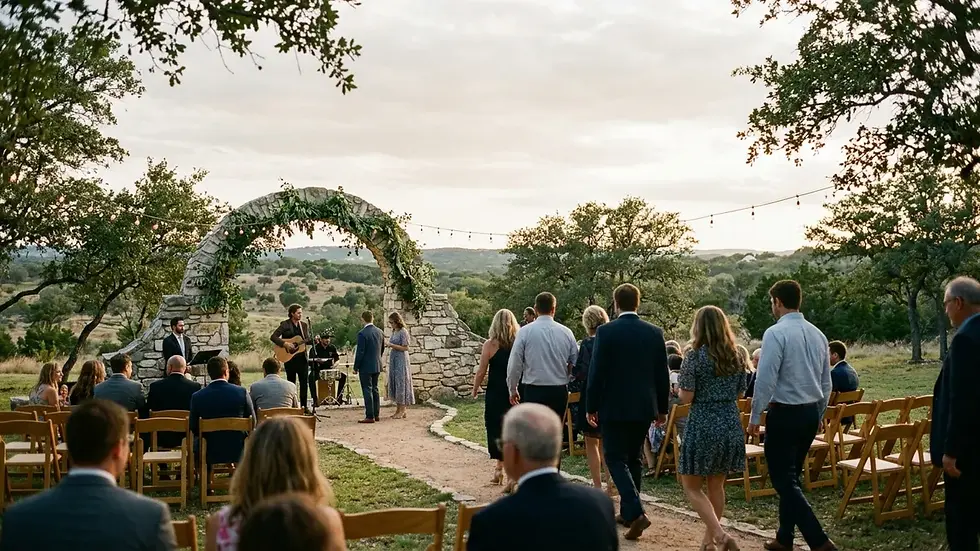
Prelude music is the live or recorded music played during the seating period before a wedding ceremony begins, typically starting 20 to 30 minutes before the processional and ending the moment the wedding party begins to walk. Prelude music serves a functional and emotional role: it sets the tonal register of the entire ceremony, manages the acoustic environment during a period that would otherwise feel awkward, and signals to arriving guests that the event has officially begun.
From a logistics standpoint, the prelude fills a real gap. Guests arrive at different times. Ushers are still seating people. The wedding party is hidden away. Without music, that 20-minute window becomes an uncomfortable social limbo where no one knows where to look or what to say. A well-chosen prelude removes that discomfort entirely.
Emotionally, the prelude telegraphs what kind of wedding this is. A string quartet playing classical repertoire signals elegance and formality. An acoustic guitarist playing softened versions of contemporary pop songs signals warmth and intimacy. A live band performing gentle instrumental arrangements of the couple's favorite songs signals personality and originality. Guests read those cues the moment they walk in, and those cues shape how they experience everything that follows.
In 2026, couples planning Austin wedding ceremonies are treating the prelude as a curated chapter rather than a default playlist, using it to establish the evening's emotional arc before the ceremony even begins.

How Long Should a Wedding Prelude Playlist Be?
A wedding prelude playlist should be 20 to 30 minutes long, with 25 minutes being the most reliable target for most venue types and guest counts. This length accounts for early arrivals who may be seated up to 30 minutes before the ceremony start time, while ensuring the prelude does not drag if guests arrive closer to the scheduled hour.
The 20-minute floor matters because guests who arrive early deserve a complete musical experience, not a loop that restarts halfway through. The 30-minute ceiling matters because extended preludes risk fatigue: after 30 minutes, even beautiful music becomes sonic wallpaper, and the emotional impact of the processional diminishes when guests have been sitting too long.
A practical way to build the playlist: select your songs, calculate total runtime, and then add two buffer songs you can cut if the ceremony starts close to on time. This gives you flexibility without the awkward silence of running out of music early.
For outdoor Texas weddings, particularly those held at Hill Country venues from September through November, cap the prelude at 25 minutes even if the ceremony start is scheduled for 30 minutes out. Guests standing in the sun waiting for a prelude to finish become uncomfortable guests, and that affects the room's energy when the ceremony actually begins.
How Many Prelude Songs for a Wedding Should You Plan?
For a standard 20 to 30 minute prelude, you should plan 6 to 10 songs, depending on the average track length. Most contemporary songs run 3 to 4 minutes, which means 7 to 8 songs cover a 25-minute window comfortably. Classical instrumental pieces often run longer, sometimes 5 to 7 minutes, so fewer selections may be needed for a classical prelude program.
A useful rule: always queue one or two more songs than you think you need. Ceremonies run late more often than they run early. Guests with mobility considerations may take longer to be seated. A delayed officiant or a missing ring pillow can push the processional back by 5 to 10 minutes. Having two extra songs in reserve means a live musician or DJ can extend the prelude gracefully without a gap.
Here is a practical breakdown by prelude length:
Prelude Length | Songs at 3-4 Min Each | Songs at 5-6 Min Each | Buffer Songs to Add |
20 minutes | 5 to 6 songs | 3 to 4 songs | 1 to 2 |
25 minutes | 6 to 8 songs | 4 to 5 songs | 2 |
30 minutes | 7 to 10 songs | 5 to 6 songs | 2 to 3 |
Live performers have a distinct advantage here. A skilled musician can extend a piece, repeat a section, or improvise a brief transition to fill time without the abrupt silence that a playlist creates when it runs out. This is one of the most practical arguments for booking live ceremony music rather than relying on a curated Spotify queue.
What Is the 50/30/20 Rule for Weddings and How Does It Apply to Music?
The 50/30/20 rule for weddings is a wedding planning framework that divides the ceremony's total time into three proportional blocks: 50% for the ceremony itself (vows, readings, rituals), 30% for music and atmosphere (including prelude, processional, recessional, and any musical interludes), and 20% for transitions and logistics (seating, bridal party movement, signing of documents).
For a 60-minute ceremony timeline, that formula translates to roughly 30 minutes of ceremony content, 18 minutes of music, and 12 minutes of transitional logistics. For a 90-minute ceremony, the music allocation grows to approximately 27 minutes, which aligns closely with the 25 to 30 minute prelude recommendation.
The 50/30/20 rule is most useful as a proportionality check rather than a rigid formula. If your ceremony includes elaborate cultural rituals, the 50% ceremony block may expand. If your venue has acoustical challenges that make long musical passages uncomfortable, keeping the 30% music block on the shorter end of its range is reasonable.
What the rule consistently confirms: music, including the prelude, should account for nearly a third of the ceremony's total time. Couples who treat prelude music as a two-song afterthought are shortchanging both the guest experience and the emotional architecture of their ceremony. For couples in the Austin, Texas area exploring how music shapes a ceremony's full arc, our resources on Texas wedding bands offer practical context on what professional ceremony music looks like in practice.
What Is the 30-5 Rule for Weddings?
The 30-5 rule for weddings is a practical timing guideline used by wedding planners and officiants: start the prelude music 30 minutes before the scheduled ceremony time, then wait 5 minutes past the scheduled start time before cueing the processional. The 5-minute buffer accounts for late arrivals and prevents the ceremony from beginning with a partially empty room.
The 30-minute prelude start is the standard most professional musicians plan around. It gives guests who arrive on time or slightly early a full, complete musical experience. It also gives ushers and coordinators enough time to seat the house in an organized, unhurried way before the processional demands full attention from everyone.
The 5-minute hold is the piece most couples underestimate. At nearly every wedding, a meaningful percentage of guests arrive in the final 5 minutes before the scheduled start. Starting the processional exactly on time means those guests are still standing in the back or being shuffled to seats while the wedding party walks. The 5-minute cushion fixes this without meaningfully extending the overall event timeline.
One important note: the 30-5 rule assumes a single, continuous prelude period. If your ceremony design includes a cocktail period before guests are seated (a reverse-order format sometimes used for intimate ceremonies), the prelude timing shifts accordingly and should be discussed with your musician or entertainment coordinator during the planning process.

How Does Venue Type Affect Prelude Music Length?
Venue type is one of the most underweighted variables in prelude music planning. The physical environment determines acoustics, guest comfort, and the practical limits of how long a prelude can run before diminishing returns set in.
Indoor venues (hotel ballrooms, converted warehouses, historic chapels) benefit from longer preludes because guests are comfortable and the acoustic environment is controlled. A 25 to 30 minute prelude works well in these settings. High-ceilinged ballrooms in downtown Austin, for example, create a natural reverb that makes live string music feel immersive, rewarding a fuller prelude program.
Outdoor venues require more conservative planning. Heat, wind, ambient noise, and the physical discomfort of standing or sitting in direct sunlight all reduce guest tolerance for extended waiting periods. For outdoor Hill Country weddings, the most experienced Texas venue coordinators recommend capping the prelude at 20 to 22 minutes and staging the processional promptly. A September evening ceremony at an open-air venue along the 290 corridor has a narrow window of ideal light and temperature; spending 30 minutes on the prelude burns through that window unnecessarily.
Religious venues (churches, synagogues, chapels) often have their own traditions and protocols around prelude music. Many churches traditionally begin prelude music 15 to 20 minutes before the ceremony and follow a set program of liturgical or classical selections. If your ceremony is held at a religious institution, confirm the expected prelude format with the venue coordinator or music director rather than assuming the standard 25-minute window applies.
For couples planning ceremonies at Texas venues with known acoustic profiles, the team at Cap City Band regularly advises on how to match prelude song selection and length to the specific environment, whether that means a stone-walled Texas Hill Country chapel or an open-air courtyard in San Antonio.
What Are the Best Types of Prelude Songs for a Wedding Ceremony?
The best prelude songs for a wedding ceremony are pieces that establish the emotional tone of the day without demanding active attention from guests. The prelude is a background experience by design: guests are arriving, finding seats, greeting each other, and orienting themselves to the space. Music that commands attention, like an uptempo pop hit or a dramatic orchestral piece, works against that function.
Strong prelude repertoire falls into three broad categories:
Classical and instrumental standards: Pieces by Bach, Pachelbel, Debussy, and similar composers have served as prelude staples for generations because their harmonic structures feel simultaneously familiar and formally elevated. Pachelbel's Canon in D and Bach's "Air on the G String" remain reliable choices across venue types and guest demographics.
Acoustic or instrumental arrangements of contemporary songs: A fingerpicked acoustic version of a favorite indie song, or a piano arrangement of a pop ballad the couple loves, adds personality without disrupting the pre-ceremony atmosphere. These arrangements signal that this wedding has a distinct identity while keeping the energy appropriately understated.
Original or genre-specific instrumental music: Jazz standards, bossa nova arrangements, and folk instrumentals all work well depending on the couple's aesthetic and the venue's character. A Hill Country venue with cedar beams and string lights suits acoustic folk. A downtown Houston ballroom might suit a jazz piano trio's prelude program more naturally.
The consistent principle: prelude songs should be melodically pleasant, rhythmically unhurried, and emotionally warm. Save the dramatic peaks for the processional, the recessional, and, if you have a live band for the reception, the first dance reveal. For couples building a complete ceremony-to-reception music plan, our guide to top 40 hits played live at your wedding covers how popular songs translate from ceremony to reception energy.
How Does Live Music Change the Prelude Experience Compared to a Playlist?
Live prelude music creates a fundamentally different guest experience than a recorded playlist, primarily because a live performer responds to the room in real time. A recorded playlist cannot extend a song because the ceremony is running 7 minutes late. A live musician can. A recorded playlist cannot read the energy of a half-filled venue and adjust tempo accordingly. A live performer does this instinctively.
From a purely practical standpoint, live prelude music eliminates several common failure points: Bluetooth connectivity drops, phone notifications interrupting a playlist mid-song, volume levels that feel right on a phone speaker but too loud or too quiet in a 200-person venue. These are not hypothetical risks. Venue coordinators across Austin, Dallas, and Houston report that tech-related audio failures during preludes are among the most common ceremony disruptions they manage.
The experiential difference is equally significant. Guests who walk into a ceremony where a cellist is performing live, or where a guitarist is fingerpicking a recognizable melody, immediately understand that this couple invested in the moment. The physical presence of a musician performing in the same space creates a social connection that a speaker in the corner cannot replicate.
For couples who want the warmth of live ceremony music but are working within a defined budget, a solo acoustic performer, a duo, or a small ensemble for the ceremony combined with a full live band for the reception is a common and effective approach. The ceremony sets the intimate tone; the reception delivers the energy. Many Austin wedding bands offer ceremony music packages that cover both components under a single booking, which simplifies coordination considerably.
Prelude Music Planning at a Glance: A Quick Reference Guide
The following reference table consolidates the key prelude music planning benchmarks discussed in this article. Use it as a quick planning checklist when building your ceremony music timeline.
Planning Variable | Standard Recommendation | Notes |
Total prelude length | 20 to 30 minutes | 25 minutes is the most practical target for most venues |
Number of songs | 6 to 10 songs | Based on 3 to 4 minute average track length; add 2 buffer songs |
When prelude starts (30-5 rule) | 30 minutes before ceremony start time | Begin processional 5 minutes after scheduled ceremony start |
Music's share of ceremony time (50/30/20 rule) | Approximately 30% of total ceremony time | Prelude is included in the 30% music allocation |
Outdoor venue cap | 20 to 22 minutes maximum | Heat and ambient noise reduce guest tolerance for longer preludes |
Indoor venue range | 25 to 30 minutes | Controlled acoustics support a fuller prelude program |
Live vs. recorded music advantage | Live music preferred for flexibility and atmosphere | Live performers can extend or shorten the prelude in real time |
What Mistakes Do Couples Make When Planning Wedding Prelude Music?
Prelude music planning is where ceremony logistics most often break down, usually because couples leave it until the final planning stages when they have already spent their decision-making energy on larger choices. Here are the most common mistakes, and how to avoid them.
1. Planning too few songs. Six songs for a 30-minute prelude is a common shortfall. If the ceremony runs late, you will have 5 minutes of silence before the processional begins. Build your playlist to cover the full 30-minute window plus two extras.
2. Choosing prelude songs based on personal favorites rather than acoustic function. Your favorite song may be a driving rock anthem that you love. As a prelude selection, that energy is jarring when guests are quietly finding seats and reading the program. Match prelude song energy to the room's function, not the dance floor's.
3. Forgetting to brief the musician or coordinator on the processional cue. The transition from prelude to processional is the most critical moment in ceremony music. Your musician needs a clear, agreed-upon signal for when to stop the prelude and begin the processional piece. A visual cue from the wedding coordinator, a specific count, or a predetermined signal from the officiant all work. Ambiguity here causes exactly the kind of awkward pause that prelude music is designed to prevent.
4. Ignoring venue acoustics. A playlist calibrated for Bluetooth speaker volume in your apartment will sound completely different in a 200-person chapel or an open-air courtyard. Always do a sound check in the actual venue space, or work with a performer who has experience in that specific venue or venue type.
5. Treating the prelude as separate from the rest of the ceremony music plan. The prelude, processional, interlude, and recessional should form a cohesive musical narrative. Couples who plan each piece in isolation often end up with tonal whiplash: a classical prelude followed by a pop processional followed by a classical interlude. The full arc should feel intentional. For couples who want guidance on building that arc from ceremony through the last dance, our post on wedding music magic and live performance covers how professional musicians approach full-event music curation.
6. Booking live ceremony music too late. In the Austin, Texas market and across major Texas wedding markets, professional musicians and bands with ceremony experience fill their peak-season dates well in advance. If your wedding date falls between April and June or September through November, begin outreach at least 10 to 12 months ahead. The best acts are not available last minute.
Frequently Asked Questions About Wedding Prelude Music
How long should a wedding prelude playlist be?
A wedding prelude playlist should be 20 to 30 minutes long, with 25 minutes being the most reliable target for most venues and guest counts. Plan for the prelude to start when the first guests are seated and end when the processional begins. Always include two buffer songs in case the ceremony starts later than scheduled.
How many prelude songs for a wedding do I need?
For a 25-minute prelude, plan 6 to 8 songs if each track averages 3 to 4 minutes. Classical pieces often run longer, around 5 to 7 minutes each, so 4 to 5 selections may be sufficient for a classical program. Add two extra songs as a buffer in case the ceremony is delayed.
What is the 50/30/20 rule for weddings?
The 50/30/20 rule is a wedding planning framework that divides ceremony time into three blocks: 50% for the ceremony content (vows, readings, rituals), 30% for music and atmosphere (including the prelude, processional, and recessional), and 20% for transitions and logistics. For a 90-minute ceremony, this allocates approximately 27 minutes to music, which aligns with standard prelude length recommendations.
What is the 30-5 rule for weddings?
The 30-5 rule means starting prelude music 30 minutes before the scheduled ceremony time and waiting 5 minutes past the scheduled start before cueing the processional. The 5-minute hold gives late-arriving guests time to be seated without disrupting the start of the processional, which is one of the most photographed and emotionally significant moments of the ceremony.
Should prelude music be live or recorded?
Live prelude music is strongly preferred over a recorded playlist when the budget allows. A live performer can extend or shorten the prelude in real time based on whether the ceremony is running early or late, eliminating the awkward silence that a playlist creates when it runs out. Live music also creates an immediate sense of occasion that recorded audio cannot fully replicate.
What type of music works best for a wedding prelude?
Prelude songs should be melodically pleasant, rhythmically unhurried, and emotionally warm. Classical instrumental standards, acoustic arrangements of contemporary songs, and gentle jazz or folk instrumentals all work well. Avoid high-energy or lyrically dominant songs during the prelude; save those for the recessional or reception. The prelude should set a tone, not demand attention.
Does venue type affect how long the prelude should be?
Yes, venue type is a key variable. Indoor venues with controlled acoustics can support a full 25 to 30 minute prelude comfortably. Outdoor venues, particularly in Texas where heat and ambient noise are factors, typically warrant a shorter prelude of 20 to 22 minutes. Religious venues may have their own prelude traditions that should be confirmed with the venue's music director.
When should prelude music stop and the processional begin?
Prelude music should stop the moment the signal is given to begin the processional, typically 5 minutes after the scheduled ceremony start time per the 30-5 rule. The transition cue should be agreed upon in advance between the musician and the wedding coordinator, whether that is a visual signal, a specific count, or an agreed verbal cue. Ambiguity at this transition is the most common cause of awkward pauses in ceremony music.
Ready to Make Your Ceremony Music Unforgettable?
Prelude music is not an afterthought. It is the first 25 minutes of your wedding experience, and it shapes how every guest feels before a single word is spoken. The standard recommendation holds across venue types, guest counts, and musical styles: plan for 20 to 30 minutes, queue 6 to 10 songs, start 30 minutes before your ceremony time, and give your processional a clean 5-minute buffer to begin. Add live music, and you add the flexibility and atmosphere that no playlist can fully deliver.
In 2026, couples who treat ceremony music as a complete, planned arc from prelude through recessional consistently report that their guests comment on the ceremony's emotional coherence more than almost any other element. That coherence does not happen by accident. It happens through planning, through the right musical choices, and through performers who understand the difference between filling silence and creating an experience.
Every Cap City Band wedding booking starts with a conversation about your full event arc, from the first prelude note through the last dance. If you are planning a wedding in Austin, Houston, Dallas, or San Antonio and want live music that serves every phase of your day with intention and professionalism, reach out and let's talk through what your ceremony and reception should sound like. Request a quote at Cap City Band and bring everything you just learned to the conversation.

Written by Suzanne Davila, Owner/Performer at Cap City Band


Comments