
Live Band vs DJ for Wedding: What Austin Couples Should Know


The live band vs DJ for wedding decision comes down to three things: budget, guest engagement, and how much atmosphere you want during dinner versus the dance floor. A live band typically costs more, averaging around $4,500 nationally versus roughly $1,800 for a DJ according to The Perfect Wedding's 2026 pricing data, but bands also generate measurably higher dance floor participation and social sharing. Neither choice is objectively "better." The right pick depends on your crowd, your venue, and how much you value live showmanship over song-catalog flexibility.
Cost gap: Live bands average $4,500 versus $1,800 for DJs nationally, a roughly $2,700 difference, per The Perfect Wedding and WeddingWire's cost guide.
Guest engagement: Live band events show 58 percent dance floor participation compared to 42 percent for DJ-only events, based on data across 347 corporate events analyzed by uRequest.live.
Adoption trend: 71 percent of US couples choose a DJ and only 12 percent book a live band, per The Knot's 2026 Real Weddings Study, largely driven by cost.
Hybrid is rising: Roughly 18 percent of couples now choose a combined band-and-DJ format, and for weddings over 200 guests, about 40 percent go hybrid, according to Lupa Entertainment's 2026 data.
Space and logistics differ: A five-to-six piece band needs 9 to 12 square meters of flat stage area, while a DJ setup needs only 2 to 3 square meters.
Myth alert: Live bands do not play continuously. Bands typically perform 45-minute sets with 15 to 20 minute breaks, which matters for your reception timeline.
At Cap City Band, we field the live band versus DJ question on nearly every consultation call, whether the couple is planning a reception at a Hill Country venue outside Austin or a ballroom downtown. Most couples arrive with assumptions picked up from wedding forums that do not hold up once you look at real 2026 pricing and venue logistics. This article breaks down the most common myths about band versus DJ and replaces them with what actually happens on the ground in Texas.
We are not neutral on this topic. Our team performs weddings across Austin, Houston, San Antonio, and Dallas, and we have watched both formats succeed and fail depending on execution, not format alone. What follows is myth-busting built on real market data and years of load-in, sound check, and dance floor experience, not generic vendor talking points.
Myth: A Live Band Always Costs Twice as Much as a DJ
The claim that bands universally cost double a DJ is an oversimplification of a wider price range. According to The Knot's internal study data, average band pricing sits near $4,500 in 2026 while DJs average around $1,800, a gap of roughly 150 percent, not a flat "double." Specifically, Wedding-Spot cites Mole Street Artists pricing where smaller 4-to-8 piece reception bands run $3,000 to $5,000, well under double a premium DJ package.
In Texas specifically, Uptown Drive's market analysis found bands starting around $2,500 for a trio and climbing to $8,000-plus for a full band with horns and multiple vocalists, while the national DJ average sits closer to $1,567. As a result, the actual multiplier depends heavily on band size and vocalist count, not a fixed industry rule.
Budget quartiles tell a clearer story. Couples in the lowest spending quartile pay around $900 for a band and $800 for a DJ, essentially at parity. Couples in the highest quartile pay about $7,000 for a band versus $2,700 for a DJ. The gap widens as production value increases, not as a fixed percentage across every booking.
Is a Live Band Worth It for a Wedding?
A live band is worth the added cost for couples who prioritize atmosphere, guest engagement, and a reception that feels like an event rather than a playlist. Live band events generate 45 percent higher engagement scores and 60 percent more social media activity than DJ-only events, based on event impact data compiled by uRequest.live. That is a meaningful difference if you want a reception people talk about afterward.
Across 347 corporate events studied, live band settings produced 58 percent dance floor participation and an average 2.8-hour guest stay time, compared to 42 percent participation and 2.1 hours for DJ events. Weddings track similarly: a live vocalist reading the room in real time tends to keep reluctant dancers engaged longer than a pre-programmed set.
That said, a live band is not automatically worth it if the band cannot adapt. A technically skilled group that plays the identical set regardless of the crowd does not justify the premium. This is exactly why setlist customization matters so much, and why our vocalists, including Forte Appling and Suzanne Van Velson, build flexibility into every reception rather than locking in a fixed 40-song list months in advance.

Is a DJ or Live Band More Expensive?
A live band is more expensive than a DJ in nearly every documented market comparison. WeddingWire reports a national average of $4,500 for bands against $1,000 for DJs. The Knot's 2022 figures showed $3,900 versus $1,500, and its 2026 update places bands closer to $4,500. Zola's range runs $3,000 to $10,000 for bands and $500 to $2,000 for DJs.
Regional variation matters too. In the Netherlands, Lupa Entertainment's 2026 data shows bands running 2,500 to 4,500 euros against 800 to 1,200 euros for DJs, roughly a threefold spread. In the UK, Motion Entertainment states wedding bands typically cost three to five times more than a DJ, with DJs at 350 to 800 British pounds and bands from 1,200 to 4,000-plus pounds for an evening.
Why the persistent gap? A DJ is usually one professional with a laptop, speakers, and a licensed music library. A band splits its fee among four to eight or more musicians, each paid for rehearsal time, travel, and equipment. Insider Weddings notes that band pricing scales with headcount and experience level, while a DJ's base cost stays comparatively flat regardless of song catalog size.
Myth: DJs Offer More Song Variety Than Bands
This myth has real merit but gets overstated. A DJ genuinely draws from a nearly unlimited digital catalog, while a band's live repertoire is finite. Disctilldawn notes that bands typically rehearse and perform 40 to 80 songs, compared to a DJ's access to millions of tracks. If you need a specific, obscure song played note-for-note, a DJ wins that argument outright.
But variety is not the same as fit. A well-booked band curates its repertoire specifically for your guest list, factoring in age ranges, regional taste, and moments like the first dance or parent dances. Cap City Band's setlist consultation process exists precisely because a generic 60-song list rarely satisfies both your college friends and your grandparents equally well.
Additionally, most professional bands can build custom arrangements of specific requested songs when given enough lead time, something a purely pre-recorded DJ set cannot replicate in the same live, in-the-room way. The honest answer: DJs win on raw catalog size, but bands win on tailored delivery and live arrangement flexibility.
Myth: Live Bands Play Continuously All Night
Live bands do not perform without interruption. A working band typically performs sets of 45 minutes followed by 15 to 20 minute breaks, according to Lupa Entertainment's 2026 operational data. Disctilldawn confirms this same rhythm, noting bands usually rest every 45 minutes while DJs provide continuous, gap-free music throughout the reception.
This matters practically. If your reception timeline is tight, those breaks need planning, typically filled with recorded playlist music, often run through the same sound system the band uses. A well-organized band handles this transition seamlessly with pre-loaded playlists, but it is a coordination detail many couples do not anticipate when comparing formats.
DJs, by contrast, offer uninterrupted coverage for the full booking window, usually four to six hours of ceremony-and-reception coverage in standard packages. If constant, unbroken music matters more to you than live vocal performance, that is a legitimate point in the DJ column. It is also why some Austin couples ask us directly how we structure breaks, and why we build the transition into the run-of-show before the event, not during it.
What Does the Age Mix of Your Guest List Mean for Band vs DJ?
Guest list demographics should directly shape your entertainment choice, a factor most wedding guides skip entirely. If your guest list skews heavily toward guests under 30, a DJ with a broad, current catalog and continuous mixing often keeps that younger crowd moving without interruption. If your list spans multiple generations, with a meaningful share of guests over 50, a live band's vocal-driven, dynamic arrangements tend to bridge those gaps more effectively than a strictly programmed playlist.
Consider a rough framework: if under 30 percent of your guests fall outside the 25-to-40 range, a DJ's song variety advantage carries more weight. If more than half your guest list spans three or more generations, a band's ability to shift energy in real time, reading whether the room wants classic Motown, current pop, or Texas dance standards, becomes the more valuable investment.
This is where a hybrid approach genuinely earns its reputation. A live band for cocktail hour and early reception, followed by a DJ for late-night dancing, lets you cover both ends of the demographic spread without over-committing budget to either format alone.
Hybrid Band and DJ Weddings: The Underexplained Middle Ground
A hybrid wedding entertainment format combines a live band for part of the evening, typically ceremony music, cocktail hour, and dinner, with a DJ handling late-night dancing. According to Lupa Entertainment's 2026 figures, hybrid weddings run 3,500 to 5,500 euros in the Netherlands, positioned between standalone DJ and full-band pricing, and 18 percent of Dutch couples now choose this format.
The adoption pattern is even stronger at larger events. Approximately 40 percent of couples with weddings over 200 guests choose the hybrid band-and-DJ format, likely because bigger receptions have longer entertainment windows where audience energy naturally shifts from dinner-hour ambiance to late-night dance intensity.
Fuse Weddings owner Mara Mazder, who works Utah and Park City markets, has noted the combo trend growing specifically because couples want live energy during key moments, the entrance, first dance, toasts, without paying full band rates for the entire night. This is a real budget lever few competitor articles explain clearly: negotiating a shorter band booking, say 90 minutes covering cocktail hour and first dance, paired with a DJ for the remaining hours, often lands closer to $3,500 to $5,500 total rather than stacking full separate fees.
Cap City Band's sister band option exists partly to serve this exact hybrid need, giving couples flexibility in sound and format without managing two completely separate vendor relationships and contracts.

How Do Venue Acoustics and Noise Limits Affect the Decision?
Venue acoustics and local noise ordinances directly constrain whether a live band or DJ makes practical sense, a factor competitor guides rarely address in depth. A five-to-six piece band needs 9 to 12 square meters of flat stage area for instruments and monitors, while a DJ setup requires only 2 to 3 square meters, according to Lupa Entertainment's operational benchmarks. Outdoor Hill Country venues around Austin often have generous space but strict evening sound curfews tied to residential proximity.
Indoor ballrooms with hard surfaces, marble floors, high ceilings, minimal soft furnishing, can create excessive reverb for a full drum kit and horn section, requiring careful sound engineering that a smaller DJ setup avoids entirely. Conversely, outdoor tented receptions often favor a band's ability to fill open-air space with acoustic presence that recorded sound through smaller speakers can struggle to match.
Additionally, most US municipalities require some form of entertainment permit or one-day license for public events, including outdoor weddings, with fees varying by jurisdiction. And public performance of licensed recorded music generally requires coverage under performance rights organizations such as ASCAP, BMI, or SESAC, unless the venue's blanket license already covers it. Confirm with your venue coordinator which licenses are already in place before booking either format.
Cost, Engagement, and Logistics: Live Band vs DJ Comparison Table
Factor | Live Band | DJ |
Average US cost (2026) | $4,500 | $1,800 |
Budget range | $3,000 to $10,000+ | $500 to $2,000 |
Dance floor participation | 58 percent | 42 percent |
Stage/setup space needed | 9 to 12 sq meters | 2 to 3 sq meters |
Music continuity | 45-min sets, 15 to 20-min breaks | Continuous coverage |
Song catalog size | 40 to 80 rehearsed songs | Millions of tracks |
US couples choosing (2026) | 12 percent | 71 percent |
Best for | Multi-generational guest lists, high-energy moments | Budget flexibility, uninterrupted mixing |
As shown above, the choice is not simply which format is "better." It is which trade-off, cost versus engagement, catalog size versus curated performance, matches your specific reception.
Is $100 an Hour Good for a DJ?
A $100-per-hour DJ rate falls within a reasonable range for a standard wedding reception booking, particularly for a four-to-six hour package landing near the national average of $1,700 to $1,800. Thumbtack data cited by Wedding-Spot shows DJ averages closer to $500 to $600 for simpler bookings, while more experienced DJs with full sound and lighting rigs push toward $1,200 or higher for the same time window.
Whether $100 an hour is a good rate depends heavily on what is included. A rate that only covers music playback without MC duties, ceremony sound, or lighting is a different value proposition than a full-service package. Ask specifically whether the hourly rate includes setup and breakdown time, which many DJs bill separately, or whether it is purely performance hours.
For comparison, a live band's per-musician cost at the low end of the Texas market, roughly $2,500 for a trio per Uptown Drive's data, works out to significantly more per hour once you factor in the smaller act size. The math only favors a band once you add vocalists and full instrumentation that a solo DJ cannot replicate.
Is $1,500 a Lot for a Wedding DJ?
A $1,500 wedding DJ booking sits near or slightly above the documented national average, making it a reasonable, not excessive, price point. The Knot's 2022 data placed average DJ cost at $1,500, and more recent figures from The Perfect Wedding show the 2026 average closer to $1,800, meaning $1,500 actually undercuts current market averages slightly.
Great Family Artists' 2026 guide places DJ ranges between $1,000 and $5,500 depending on market and package inclusions, positioning $1,500 firmly in the lower-middle tier. PTP DJ's data shows a national DJ average around $1,875, again suggesting $1,500 is a fair, moderately priced booking rather than a premium one.
What separates a fair $1,500 DJ from an overpriced one is scope. Confirm the quote includes ceremony sound, cocktail hour music, MC announcements, and reception lighting, not just a bare-bones playback service. If those extras are add-ons pushing the total well past $1,500, negotiate line by line rather than accepting a bundled rate.
How to Choose: A Practical Decision Framework
Choosing between a live band and a DJ for your wedding, or a hybrid of both, comes down to five practical checkpoints. Work through these in order before signing any contract.
Set your entertainment budget as a percentage of total spend. Industry planners commonly suggest around 5 percent of total wedding budget for a DJ and up to 15 percent for live music. Victorious Events NYC recommends this 5 percent to 15 percent range as a starting benchmark before requesting quotes.
Map your guest list age distribution. A younger, single-generation crowd favors DJ catalog breadth. A multi-generational list favors a band's adaptive energy.
Check your venue's space and noise constraints. Confirm stage footprint (9 to 12 square meters for a band versus 2 to 3 for a DJ) and any sound curfews with your coordinator before booking.
Decide if you need continuous coverage or can plan around breaks. If gapless music matters, budget for a DJ during band breaks or choose DJ-only.
Ask about setlist customization and MC duties upfront. A band that customizes its list to your specific crowd, and can also handle announcements, reduces the need for a separate MC hire.
Common mistakes we see: booking based on price alone without checking what is included, assuming a bigger band automatically means a better reception, and failing to confirm break coverage until the week of the wedding. New Orleans-based planner Michelle Norwood Events has noted that couples who lock in entertainment specifics early, not just a vendor name, avoid the most common day-of surprises.

Frequently Asked Questions
How far in advance should I book a live wedding band in Austin?
Most Austin couples should book six to nine months ahead of their wedding date, especially for peak spring and fall wedding season. In-demand bands with named, credentialed vocalists book out faster than solo DJs, so lock in your date as soon as your venue is confirmed.
Does Cap City Band perform for both the ceremony and the reception, or just the reception?
Cap City Band can cover both ceremony and reception music depending on your package, eliminating the need for a separate ceremony musician contract. Our setlist consultation covers processional, recessional, cocktail hour, and full reception dance sets in one coordinated booking.
How customizable is the setlist? Can we request specific songs?
Yes, our setlist process is built around your specific guest list and preferences, not a fixed 40-song template. Couples work directly with our vocalists, including Forte Appling and Suzanne Van Velson, to build a list that covers first dance, parent dances, and dance-floor staples suited to your crowd's age range.
What is the typical price range for a live band at an Austin wedding?
Texas band pricing generally starts around $2,500 for a smaller trio format and can reach $8,000 or more for a full band with multiple vocalists and horns, according to Uptown Drive's market analysis. National averages sit near $4,500 as of 2026, though your final quote depends on band size, hours, and travel.
Can Cap City Band travel to Houston, Dallas, or San Antonio for events?
Cap City Band regularly performs across Houston, Dallas, and San Antonio in addition to our home Austin market. Travel logistics and fees are factored into your custom quote, and our team has experience adapting our show to venues throughout Central Texas and beyond.
Does Cap City Band provide MC services, or is that a separate hire?
Our vocalists handle MC duties as part of the standard performance, including announcements, toasts cues, and reception timeline coordination. This eliminates the coordination confusion that comes from managing a separate MC vendor alongside your entertainment.
What is live band karaoke, and how does it work at a wedding or corporate event?
Live band karaoke is an interactive format where guests join the live band on stage to sing lead vocals over a live instrumental performance, rather than singing over a pre-recorded backing track. It is a specific differentiator that turns passive listening into active guest participation, and it works particularly well during the later hours of a wedding reception or corporate celebration.
Conclusion: Which Should You Book?
The live band vs DJ for wedding decision ultimately hinges on what you value most: a DJ's budget efficiency and unbroken catalog access, or a live band's higher engagement and adaptive energy, backed by the 58 percent versus 42 percent dance floor participation gap documented across hundreds of events. Neither format is universally correct, and the fastest-growing option in 2026, the hybrid band-and-DJ format, exists precisely because most receptions benefit from both strengths at different points in the night.
Start with your guest list demographics and venue constraints, not just the sticker price. A band costing $4,500 that keeps three generations dancing may deliver more value than a $1,800 DJ package that only satisfies half the room. Whatever you choose, confirm what is actually included in the quote before you sign.
If you are still weighing your options, our team at Cap City Band walks Austin, Houston, San Antonio, and Dallas couples through this exact decision every week, and we are glad to talk through what fits your specific reception. You can also browse our guide to the best of Austin wedding bands or read more on how Austin bands lead group dances for additional planning context.

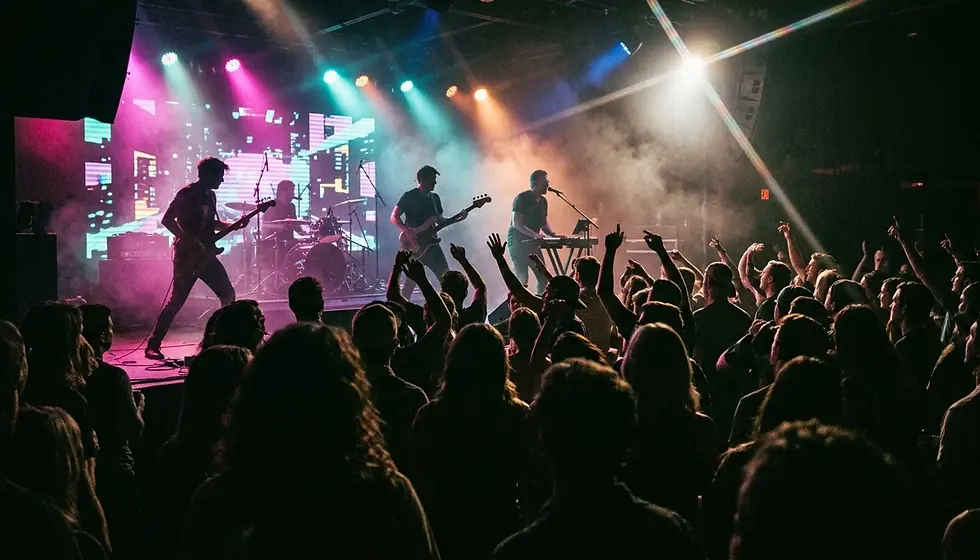
If the dance floor energy in that photo is what you picture for your own reception, that is exactly the choreographed, multi-vocalist show Cap City Band builds around every wedding we book. Get started with Cap City Band and we will walk you through what a custom setlist and live show look like for your specific date.
Written by Suzanne Davila, Owner/Performer at Cap City Band
Content powered by inkSTR.co

Comments