
Pricing Strategy for Live Bands: What Sets Rates in Texas


A pricing strategy for live entertainment is the method a band or entertainment company uses to set what it charges, based on factors like vocalist lineup, event type, season, and market demand rather than a single flat number. For Texas weddings and corporate events, the strategy that actually protects you as a buyer is value-based pricing tied to what's included in the booking, not the lowest quote on a spreadsheet.
Key Takeaways
Most professional pricing strategies fall into a handful of recognizable types: value-based, competitive, cost-plus, penetration, skimming, economy, and dynamic pricing, each suited to different business situations.
Texas DJ pricing, as one comparison point, ranges from roughly $950 for basic packages up to $3,200 for premium services, based on analysis of over 476,000 reviews reported by industry sources in 2026.
Live bands typically price using a value-based model built around vocalist count, instrumentation, hours of coverage, and travel, not a single hourly rate.
Event demand spikes, like SXSW and Formula 1 in Austin, shift local entertainment and hospitality pricing significantly, and the same seasonal logic applies to peak wedding and corporate booking months.
Industry research indicates that even small pricing adjustments can shift revenue by 20 to 50 percent, which is why vague, unstructured quotes should raise questions for any buyer.
Cap City Band prices its live wedding band, corporate entertainment, and live band karaoke services around vocalist depth, show format, and market, giving Austin, Dallas, San Antonio, and Houston clients a transparent framework rather than a single number pulled from thin air.
If you've requested three quotes for wedding entertainment and gotten three wildly different numbers, you've already run into the central problem with pricing strategy in live events: there's no single industry rate card. A four-piece cover band with one singer and a nine-piece show band with three lead vocalists and horns are not the same product, even though both get called "a wedding band" on a website.
This guide breaks down how pricing strategy actually works in the live entertainment world, using the same frameworks that consulting firms and pricing researchers apply to any business, then translates that into what it means for your Austin wedding, your Dallas corporate gala, or your Houston product launch. We'll cover the standard pricing types, the psychological tricks that show up on invoices, and the specific cost drivers behind live music in Central Texas as of 2026.
At Cap City Band, we've built our own pricing around a simple premise: couples and planners deserve to understand what they're paying for before they sign anything. That transparency is rare enough in this industry that it's worth explaining exactly how pricing works, not just quoting a number.
What Are the Four Main Types of Pricing Strategies?
The four main types of pricing strategies used across most industries are cost-plus, competitive, value-based, and dynamic pricing. Each method calculates price differently: cost-plus starts from expenses, competitive starts from what rivals charge, value-based starts from what the buyer gets, and dynamic pricing adjusts in real time based on demand.
Cost-plus pricing adds a fixed markup to production or delivery costs. It works well for manufactured goods but poorly for live performance, where "cost" includes intangible factors like a vocalist's stage experience or years of touring.
Competitive pricing sets rates relative to other providers in the same market, sometimes matching them directly, sometimes intentionally staying above or below. Streaming services like Netflix, Amazon Prime Video, Disney+, and Hulu roughly track each other's subscription prices, a textbook example of competitive pricing in a mature market.
Value-based pricing charges according to the specific outcome or experience delivered, not the underlying cost to produce it. Dollar Shave Club built a business on reframing value against category norms, and the same logic drives how a three-vocalist show band prices differently than a solo acoustic act.
Dynamic pricing shifts rates based on real-time demand, a model that originated with airlines and now shows up in hotel rates, sports tickets, and increasingly in event entertainment during high-demand weekends. Austin's own market shows this clearly: Formula 1 weekends in October and November drive average daily rates for premium short-term rentals up to four to eight times baseline levels, according to 2026 market data from MagicBnB, and entertainment demand follows a similar seasonal curve.
What Are the 7 Pricing Strategies Businesses Use Most?
Industry pricing research commonly identifies seven core pricing strategies: value-based, competitive, price skimming, cost-plus, penetration, economy, and dynamic pricing. These seven approaches cover the vast majority of pricing decisions made across service and product businesses, from software subscriptions to live entertainment bookings.
Strategy | How It Works | Best Fit |
Value-based | Price reflects perceived benefit to the buyer, not cost to deliver | Premium services, live entertainment, specialized expertise |
Competitive | Price set relative to other providers in the same category | Mature, crowded markets with comparable offerings |
Price skimming | High initial price, lowered over time | New products or exclusive early access |
Cost-plus | Fixed markup added to production cost | Physical goods with predictable input costs |
Penetration | Low introductory price to build market share fast | New entrants trying to displace incumbents |
Economy | No-frills, lowest viable price point | Budget-conscious segments, commodity offerings |
Dynamic | Price fluctuates with real-time demand and inventory | Airlines, hotels, event tickets, peak-season bookings |
Video game console makers, as Forbes has noted, frequently use penetration pricing: sell the hardware near cost, then recoup margin through game sales over years. Live entertainment rarely works this way because there's no recurring "software" revenue behind a single event booking, which is part of why skimming and penetration show up less in this category than value-based and dynamic models.
For Austin entertainment specifically, dynamic pricing shows up around major citywide events. Austin short-term rental data from Surge Intelligence shows March revenue running roughly 79% higher than the January trough, driven by SXSW, and that same demand curve pulls entertainment, catering, and venue pricing upward in the same weeks. Booking a band for a wedding during SXSW or the Austin City Limits festival window means competing with citywide demand spikes, not just other couples.
🔹 What is Pricing Strategy? Master Pricing Strategy & Maximize Your Profits! 🔹
What Are the 5 Pricing Strategies With Examples?
Five commonly cited pricing strategies with real-world examples are value-based pricing (Salesforce's per-seat software model), competitive pricing (streaming subscription tiers), penetration pricing (game console hardware sold near cost), price skimming (early-release premium electronics), and economy pricing (no-frills budget carriers). Each example shows a different relationship between price and perceived value.
Salesforce charges per user seat, a value metric that scales with how much benefit a customer actually extracts from the software: an approach pricing researchers at Paddle link to stronger growth and lower churn than flat-fee models.
In live entertainment, the closest equivalent to a "value metric" isn't per-seat, it's per-vocalist, per-hour, and per-instrumentation-tier. A four-piece band with a single lead singer occupies a different value tier than a nine-piece show band with three trained lead vocalists trading harmonies across genres, similar to how a Barcelona theater once experimented with charging audiences based on the number of laughs during a comedy show, a genuinely novel value-based pricing test reported by BBC News.
Does the .99 Pricing Trick Actually Work?
Charm pricing, ending a price at .99 instead of a round number, works because of how the human brain processes the leftmost digit first, making $2.99 register as meaningfully cheaper than $3.00 even though the actual difference is one cent. Retail research has repeatedly shown this effect increases conversion, particularly for lower-cost, high-frequency purchases like retail goods and subscription tiers.
Charm pricing matters less in live entertainment because event bookings aren't impulse purchases. Nobody books a $4,999 wedding band instead of a $5,000 one because the psychology tipped them over; couples and planners are comparing full packages, not single price points on a shelf. Where psychological pricing does show up in this category is anchoring: presenting a premium package first so a mid-tier package looks like the reasonable middle ground, and the decoy effect, offering three tiers where the middle option is deliberately positioned as the best value.
As of 2026, we see this anchoring tactic used across Texas entertainment quotes, sometimes to a buyer's disadvantage. A vendor might lead with an inflated "platinum" package specifically to make a mid-tier quote look modest by comparison, even if that mid-tier price is still above market. Ask any Austin entertainment vendor to explain, line by line, what separates their tiers before assuming the middle option is automatically the smart choice.
How Does Pricing Strategy Work Specifically for Live Wedding Bands and Corporate Entertainment?
Live wedding band and corporate entertainment pricing strategy is a value-based model built around vocalist count, instrumentation, hours of live performance, and travel distance, not a flat hourly rate. Unlike a DJ, who prices largely around equipment and playlist curation, a live band's price reflects the number of trained musicians on stage and the breadth of material they can convincingly perform live.
As one comparison point, Texas DJ pricing ranges from roughly $950 for basic packages to $3,200 for premium services, based on analysis of over 476,000 reviews reported by industry data in 2026. Live bands generally sit above that range because a five-to-nine-piece act with multiple lead vocalists carries higher production costs: more musicians, more gear, more rehearsal time, and more logistics for load-in and sound check.
At Cap City Band, our pricing reflects specific, verifiable factors rather than guesswork. We field three lead vocalists, including Forté Appling, an Austin music scene fixture since 2011 who has opened for acts including Sublime and Bowling For Soup, Suzanne Van Velson, who trained in vocal performance at Lamar University and has performed with established Texas acts including Rotel and the Hot Tomatoes and Memphis Train Revue, and Matt Raines, a Rhode Island native now based in Austin with a performance background spanning cruise ships, jazz venues, and Texas honky tonks. That vocalist depth is a direct input into our pricing, the same way instrumentation and hours of coverage are.
Our value proposition centers on eliminating a specific cost most couples don't anticipate: paying for separate ceremony musicians and a reception band. Cap City Band's live wedding band service covers ceremony through last dance in one contract, with a setlist built collaboratively around the couple's specific must-plays and no-plays. For corporate clients, the same logic applies to corporate event entertainment: one booking covers both hosting duties and live performance, which removes the cost and coordination risk of hiring a separate MC.

What Drives the Cost of a Live Band Up or Down in Texas?
The cost of a live band in Texas moves based on five main levers: vocalist and instrumentalist count, hours of coverage, travel distance, date and season, and add-on services like MC hosting or live band karaoke. Understanding these levers lets you negotiate from an informed position instead of comparing quotes that don't actually describe the same product.
Vocalist and instrumentalist count: A three-vocalist band with horns costs more than a four-piece cover act, and that price difference should show up in genre range and harmony depth, not just headcount.
Hours of coverage: Ceremony-only bookings cost less than full ceremony-through-reception coverage, but stitching together two separate vendors for those two blocks often costs more in total than one band covering both.
Travel distance: An Austin-based band traveling to Dallas-Fort Worth, San Antonio, or Houston typically builds in a travel fee, but that fee is usually smaller than the risk premium of hiring an unverified local act with no track record.
Date and season: Peak wedding months and major citywide events compress calendar availability, and demand-driven pricing follows the same logic that pushes Austin short-term rental rates up sharply during SXSW and ACL.
Add-on services: Live band karaoke, extended cocktail-hour sets, and MC duties added to a standard package shift the total price, and buyers should ask whether these are bundled or billed separately.
Nonprofit galas add another variable: the entertainment needs to read as elegant and mission-appropriate, not party-band energy, while still being able to dial intensity up around paddle-raise moments. That tonal flexibility is a skill, not a standard feature, and it's worth asking any prospective act for a specific example of how they've handled a fundraising program before assuming every band can do it.
What Common Pricing Mistakes Do Couples and Planners Make?
The most common pricing mistake in booking live entertainment is comparing quotes as if they represent identical products, when band size, vocalist training, and hours of coverage vary enormously between vendors even at similar price points. A second common mistake is failing to get overtime rates, travel fees, and cancellation terms in writing before signing.
Comparing apples to oranges: A $3,500 quote for a four-piece band and a $6,500 quote for a nine-piece show band with three lead vocalists aren't competing offers, they're different categories of product.
Skipping the overtime conversation: Ask any Austin entertainment vendor for their overtime rate in writing before signing; a band that hesitates to answer clearly is a red flag worth noting.
Booking too late for peak dates: Popular Austin acts book out months in advance for spring and fall wedding season, and waiting until three months out limits you to whoever still has the date open, not necessarily the best fit.
Ignoring the value metric entirely: Choosing the lowest number on a page without asking what's actually included, hours, vocalists, sound equipment, load-in logistics, often leads to hidden costs surfacing closer to the event date.
Assuming a lower quote means lower risk: The opposite is frequently true. A band with a below-market price and no verifiable performance history carries more risk of an off-script moment during a first dance or a critical toast.
A useful gut check: if a vendor can't clearly explain why their price sits where it does relative to the market, that's a sign their pricing strategy is reactive rather than intentional, and reactive pricing correlates with inconsistent service quality.
How Should You Choose a Pricing Approach as a Buyer or Business Owner?
Choosing the right pricing approach starts with identifying what you're actually buying or selling: a commodity service best priced competitively, or a differentiated experience best priced on value. For live entertainment buyers, that means evaluating quotes against specific deliverables, not against a single market average number.
For business owners setting pricing, including entertainment companies, the research is fairly consistent: businesses that build a deliberate pricing strategy outperform those that treat pricing as an afterthought. Industry pricing analysis suggests fewer than 5% of Fortune 500 companies have a function dedicated specifically to pricing, and most businesses spend under ten hours a year actually thinking about it. That gap is an opportunity: getting pricing right can be a more powerful growth lever than acquiring new customers, and small pricing adjustments have been shown to swing revenue by 20 to 50 percent in some studies.
Practical steps for buyers evaluating live entertainment quotes:
Request an itemized breakdown, not just a bottom-line number, covering vocalists, instrumentation, hours, and travel.
Ask what happens if the event runs long, and get the overtime rate in writing.
Confirm whether ceremony and reception are covered under one contract or billed as separate services.
Ask for examples of how the band handles crowd briefing, meaning how they learn your guest list's age range and musical preferences before the event.
Compare vocalist experience specifically. A trained vocalist with a classical or professional performance background delivers a different reception experience than a karaoke-circuit singer, and that difference should be reflected in price.
Other names you'll encounter while researching Texas entertainment options include the kind of generalist cover acts and DJ-plus-vendor combinations common across the state. Evaluate any of them against the same checklist above rather than against price alone.
How Does Cap City Band Structure Its Pricing for Weddings and Corporate Events?
Cap City Band structures pricing around vocalist depth, show format, and event scope, giving Austin, Dallas, San Antonio, and Houston clients a value-based quote rather than a generic flat rate. As of 2026, our pricing conversations start with the specifics: how many hours you need covered, whether you want ceremony and reception in one booking, and whether live band karaoke or MC hosting fits your event.
What separates our approach from a standard cover band quote is what's actually included. Our choreographed variety show format, built around three distinct lead vocalists rather than one singer with backup tracks, means a single booking delivers genre range spanning multiple decades. That matters for couples worried about satisfying grandparents and college roommates on the same dance floor, and for corporate planners who need a set that works during a formal cocktail hour and still fills the floor an hour later.
For weddings specifically, our Austin wedding bands service covers ceremony through last dance under one contract, eliminating the separate-vendor cost stack that drives many couples' budgets higher than expected. For corporate clients across Dallas, Houston, and San Antonio, we bring the same choreographed show format along with MC capability built into the booking, so you're not paying for a second vendor to handle announcements and transitions.
We also offer a sister band for clients who want a different sound profile for the same event portfolio, useful for corporate clients producing multiple activations in a single season who want variety across markets without vetting an entirely new act each time. And for hosts who want an interactive format instead of a traditional set, our live band karaoke offering pairs real musicians with guest vocalists, a genuinely different product from a backing-track karaoke machine or a DJ-only booth setup.
Compared to a generic four-piece cover band with a fixed setlist, or a separate DJ-plus-MC arrangement stitched together from two vendors, Cap City Band's pricing reflects a single, coordinated production. That's the value-based logic behind our rates: you're paying for vocalist versatility, show choreography, and one point of contact for the entire event timeline, not a per-hour rental of musicians.
Data & Evidence: Comparing Entertainment Pricing Approaches
The table below summarizes how different entertainment pricing models compare on cost predictability, flexibility, and what buyers should watch for. This comparison draws on verified industry pricing data rather than invented figures, and it applies across Austin, Dallas, San Antonio, and Houston markets.
Pricing Model | Typical Buyer Experience | Watch For |
DJ, flat package | Ranges roughly $950 to $3,200 in Texas based on 2026 industry data | Playlist limitations, no live vocal customization |
Live band, value-based | Priced by vocalist count, hours, and instrumentation | Confirm what's included: ceremony, reception, overtime |
Separate ceremony + reception vendors | Two contracts, two deposits, two logistics timelines | Total cost often exceeds one combined booking |
Dynamic/peak-season pricing | Rates rise during high-demand weekends and citywide events | Book 60 to 90 days out for peak dates when possible |
The peak-season pattern is worth taking seriously. Austin short-term rental data shows lead times averaging around 40 days, with operators who lock in bookings 60 to 90 days ahead consistently securing stronger terms during high-demand windows like SXSW and Formula 1 weekends, according to 2026 StaySTRA market data. The same logic applies to entertainment: booking your Austin wedding band or corporate act well ahead of peak spring and fall dates protects both your calendar options and your rate.
Deep Dive: Why Value Metrics Matter More Than Headline Price
A value metric is the specific unit a business ties its price to, per seat, per hour, per vocalist, per event, and it's considered the single most important pricing decision a company makes, according to pricing research from Paddle. Companies with a clear value metric reportedly grow at roughly double the rate of flat-fee competitors, with about half the churn and double the expansion revenue.
Applied to live entertainment, the value metric question becomes: what are you actually paying for when you book a band? If the answer is "a flat number for four hours," you have no way to evaluate whether that number is fair. If the answer is "three trained lead vocalists, full instrumentation, ceremony through reception, with a documented overtime rate," you have a value metric you can compare across vendors.
This is where BCG's pricing architecture framework, which breaks pricing into pricing basis, offer structure, and pricing mechanism, becomes genuinely useful for event buyers, not just corporate strategists. The pricing basis for a live band should be hours and vocalist count. The offer structure should clearly separate a base package from add-ons like live band karaoke or extended sets. The pricing mechanism should be fixed and disclosed upfront, not negotiated ad hoc after you've already committed emotionally to a specific act.
Nonprofit gala organizers face a particularly tricky version of this problem. A band priced purely on hours doesn't capture the actual value delivered: reading the room during a paddle raise, dialing energy down for a keynote speech, then back up for the closing dance set. That kind of program-aware performance is a skill that flat hourly pricing tends to undervalue, which is one reason experienced acts price gala bookings closer to their full wedding rate rather than a discounted "corporate hourly" number.

Practical Guidance: How to Evaluate and Negotiate a Live Entertainment Quote
Evaluating a live entertainment quote requires comparing itemized deliverables, not bottom-line totals, and confirming in writing what happens outside the standard scope. As of 2026, most reputable Texas entertainment vendors will provide a detailed breakdown if asked directly, and hesitation to do so is itself useful information.
A Practical Checklist Before You Sign
Get vocalist count and instrumentation listed explicitly in the contract, not just "professional band."
Confirm ceremony and reception coverage under one agreement if you're planning a wedding.
Ask for the overtime rate in writing before the event, not after it runs long.
Clarify travel fees upfront if you're booking a Dallas, Houston, or San Antonio event with an Austin-based act.
Request a sample of how the band handles a crowd briefing, meaning how they'll learn your guest demographics and must-play list.
Book 60 to 90 days ahead of peak dates, particularly spring and fall wedding season and any weekend overlapping major citywide events.
One trade-off worth understanding: the lowest quote in a market is rarely the lowest-risk option. A below-market price on a wedding band usually means fewer musicians, less rehearsal time, or a vocalist without the range to cover multiple genres convincingly. That trade-off might be fine for a casual private party but is a real risk for a wedding reception where a single wrong song at the wrong moment is hard to undo.
For private party hosts and holiday party organizers newer to booking live entertainment, the biggest mistake is waiting too long. Popular Austin acts, including ours, book out well ahead of the holiday season, and scrambling in November for a December event severely limits your options regardless of budget.
Frequently Asked Questions
How much does a wedding band cost in Austin, Texas?
Wedding band pricing in Austin varies significantly based on vocalist count, hours of coverage, and instrumentation, with full-service bands typically pricing above standard DJ packages, which range from roughly $950 to $3,200 in Texas according to 2026 industry data. A specific quote from Cap City Band reflects your exact hours, vocalist needs, and date, so request a quote for an accurate number rather than relying on a general estimate.
Can Cap City Band perform for both my ceremony and reception?
Yes, Cap City Band covers ceremony through last dance under a single contract, which removes the cost and coordination burden of hiring separate ceremony musicians and a reception band. This structure is a core part of our value-based pricing approach and one of the main reasons couples choose a full-service band over stitching together multiple vendors.
Does Cap City Band offer live band karaoke for private parties?
Yes, live band karaoke pairs real musicians with guest vocalists, creating an interactive experience that differs meaningfully from a backing-track karaoke machine or a standard DJ setup. It works well for milestone birthdays, holiday parties, and corporate events where hosts want guests actively participating rather than just watching a set.
How far in advance should I book entertainment for an Austin wedding or holiday party?
Book 60 to 90 days ahead of peak dates when possible, and even earlier for spring and fall wedding season or any date overlapping major Austin events like SXSW or Austin City Limits. Popular acts book out months ahead for these windows, and holiday party dates in particular fill quickly each November and December.
Can Cap City Band act as MC for my corporate event, or do I need to hire someone separately?
Cap City Band combines hosting duties and live performance in one booking, so corporate clients typically don't need a separate MC vendor. This reduces both cost and coordination risk compared to arrangements that require briefing two separate vendors on the same event timeline.
How does Cap City Band build a setlist that works for guests of different ages?
We build setlists collaboratively with couples and planners, using guest list details and must-play or no-play lists to blend eras and genres across a single show. With three distinct lead vocalists spanning different vocal styles and backgrounds, we cover a wider genre range in one booking than a typical single-vocalist cover act.
Does Cap City Band travel to Dallas, Houston, or San Antonio for events?
Yes, Cap City Band regularly travels across Central Texas and beyond, serving Dallas, Houston, and San Antonio in addition to our home Austin market. Travel fees are disclosed upfront as part of the quote, and our Austin base does not mean added logistical risk for out-of-market events.
What should I ask a band before signing an entertainment contract?
Ask for the overtime rate in writing, confirm exactly which hours and services are included, get vocalist and instrumentation counts specified rather than a vague "professional band" description, and request an example of how the act handles crowd briefing for guest demographics. A vendor that hesitates to answer any of these clearly is worth reconsidering.
Conclusion: Choosing a Pricing Strategy You Can Actually Evaluate
A sound pricing strategy for live entertainment comes down to matching what you're paying for against what's actually delivered: vocalist count, hours, instrumentation, and scope, not a single number lifted off a website. Value-based pricing, the model behind most quality live band bookings, rewards buyers who ask specific questions and penalizes those who compare quotes on price alone.
As Texas entertainment demand continues shifting with seasonal spikes around events like SXSW and Formula 1, and as more couples and planners compare full-service bands against DJ-plus-vendor combinations, the vendors who price transparently will keep winning trust over those who don't. Heading into the rest of 2026, that transparency is exactly what we've built our pricing around at Cap City Band.
If you're ready to stop guessing on entertainment costs, get started with Cap City Band and request a straight, itemized quote for your Austin, Dallas, San Antonio, or Houston event.

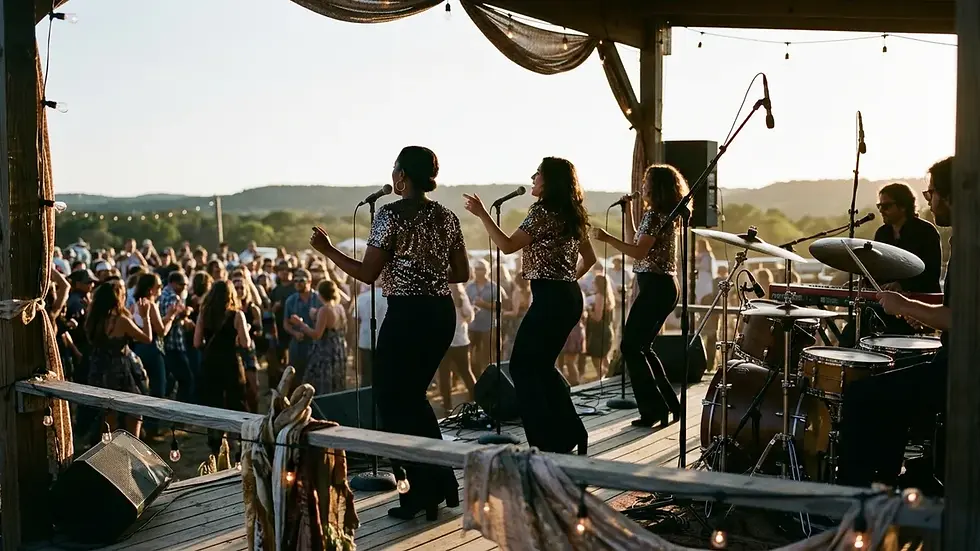
Watching a packed Texas Hill Country dance floor respond to three lead vocalists trading verses is the clearest proof that value-based pricing works the way it's supposed to: you feel exactly what you paid for. Request a quote and tell us your must-play list.
Written by Suzanne Davila, Owner/Performer at Cap City Band
Content powered by inkSTR.co


Comments