
Types of Wedding Entertainment: What Actually Works


Types of wedding entertainment generally fall into five categories: live music (bands, string quartets, soloists), DJ-led sets, interactive experiences (photo booths, live band karaoke, games), specialty performers, and ambient or late-night additions like sparkler exits. The right mix depends on your guest age range, venue restrictions, and how much of your budget you're willing to put toward the reception's energy versus its decor.
Live bands get roughly 35% of couples choosing them over DJs, and couples typically allocate $1,200 to $2,000 toward entertainment, though full-production live acts often run higher (Wedding Industry Statistics 2026).
The Knot Worldwide's 2026 Real Weddings Study found the average U.S. wedding used 13 vendors, with entertainment among the most consequential for guest experience.
Silent disco, live band karaoke, and interactive food stations are gaining ground because they solve real problems: noise ordinances, mixed-age guest lists, and dead air between dinner and dancing.
Roughly 72% of brides say they'd shift more of their budget toward entertainment if they could redo their planning, according to recent wedding industry trend data.
Not every trending entertainment idea earns its spot. Fireworks, ice sculptures, and casino tables photograph well but rarely move the needle on whether guests actually dance.
Cap City Band, an Austin, Texas based live entertainment company, works across weddings, corporate events, and private celebrations, and sees firsthand which entertainment formats hold a room and which ones just fill a schedule.
What Are the Main Types of Wedding Entertainment?
Wedding entertainment breaks down into five broad categories: live music, DJ-led programming, interactive guest experiences, specialty performers, and ambient or finale-style additions. Each category solves a different problem, from filling the dance floor to giving guests something to do during cocktail hour. Most successful receptions combine two to four types rather than trying to fit in every trend that shows up on Pinterest.
Live music includes full bands, string quartets for ceremony and cocktail hour, and solo acoustic acts. DJ-led entertainment ranges from a simple playlist operator to a full MC-driven program. Interactive experiences, including photo booths and live band karaoke, give guests something active to participate in rather than watch passively. Specialty performers, like magicians or caricaturists, work best during cocktail hour lulls. Finale additions, such as sparkler exits, close the night with a visual moment.
At Cap City Band, we've performed at hundreds of Texas events across Austin, Houston, Dallas, and San Antonio, and the pattern holds steady: couples who pick entertainment based on their actual guest list, not just what's trending, end up with the reception they wanted. As of 2026, the mix that works best usually pairs one strong live-music anchor with one or two interactive elements.
What Is the 50/30/20 Rule for Weddings?
The 50/30/20 rule for weddings is a budget framework suggesting couples allocate roughly 50% of their wedding budget to venue and catering, 30% to vendors including photography and entertainment, and 20% to attire, decor, and miscellaneous costs. It's a starting point, not a strict formula, and entertainment specifically often needs more room than a flat percentage suggests.
On a national average wedding cost of $34,000 to $36,000 in 2026, that 30% vendor slice covers photography, videography, florals, and entertainment combined. This is exactly where couples get squeezed. Live entertainment, when done as a full band rather than a DJ, can represent up to 15% of total budget, compared to roughly 5% for standard DJ services, based on 2026 wedding cost breakdowns.
Corporate event planners use a similar logic. According to industry benchmark data from The Wedding Report, entertainment companies see an average conversion rate of 90.1% from client meetings to booked events, meaning most people who inquire about live entertainment follow through once pricing makes sense. For weddings specifically, we recommend treating entertainment as its own line item, not something squeezed out of a leftover vendor percentage.
So Many Types of Wedding Entertainment!
What Are the Different Types of Wedding Programs?
A wedding program, in the entertainment planning sense, refers to the structured sequence of music and activity moments across the day: prelude, processional, ceremony, cocktail hour, grand entrance, first dance, dinner, toasts, open dance, and exit. Different entertainment types slot into different program moments, and mismatching them is one of the most common planning mistakes.
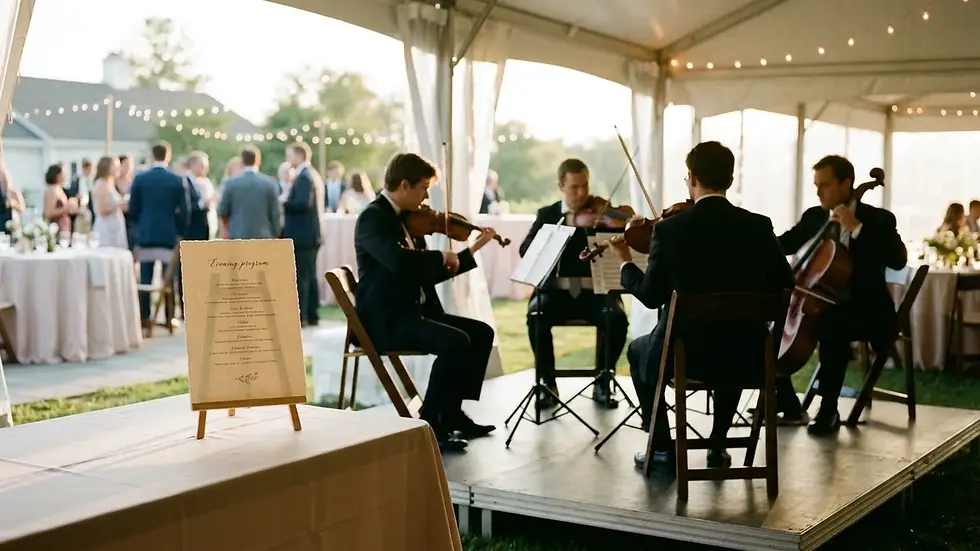
Prelude music, typically a string quartet, acoustic guitarist, or a scaled-down live band lineup, plays as guests arrive and find seats. Cocktail hour calls for background-friendly options: a jazz trio, ambient DJ set, or a specialty performer like a caricaturist working the crowd. The reception's open-dance block is where a full band or DJ carries the most weight, and it's the segment couples remember most vividly years later.
We structure our own show format around this exact sequence. Cap City Band's three lead vocalists, Forté Appling, Suzanne Van Velson, and Matt Raines, allow us to shift energy across the program without swapping performers between ceremony and reception. Forté has been a fixture in the Austin music scene since 2011, opening for acts including Sublime and Bowling For Soup. Suzanne trained in vocal performance at Lamar University and has performed with regional acts across Texas. Matt brings a background spanning cruise ships, jazz clubs, and Texas honky tonks. That range matters when one program segment needs restraint and the next needs full volume.
What Are the Different Events Within a Wedding That Need Entertainment?
A wedding includes several distinct entertainment touchpoints beyond the reception dance floor: the ceremony prelude, the cocktail hour, the reception entrance, dinner service, and the closing exit. Each moment has its own acoustic and energy requirements, and treating them identically is a common reason receptions feel flat in the middle.
The ceremony itself typically calls for a string quartet, solo vocalist, or acoustic set, something intimate enough not to overpower vows. Cocktail hour benefits from music that fills space without demanding attention, which is why jazz combos and light DJ sets dominate this slot. The reception's grand entrance and first dance need a performer capable of building anticipation, something a pre-recorded playlist often can't replicate the same way a live band reading the room can.
Dinner service usually drops energy intentionally, then the open dance floor needs to rebuild it fast. This is where interactive formats like live band karaoke shine, specifically because they turn passive dinner guests into active participants within minutes. Nonprofit galas and corporate holiday events follow a similar structure, just with a fundraising ask or executive remarks replacing toasts.
What Is the 30/5 Rule for Weddings?
The 30/5 rule for weddings refers to a general guideline that entertainment and music transitions should happen roughly every 30 minutes, with brief 5-minute breaks or format shifts to keep guest energy from plateauing. It's less an official industry standard and more a practical rhythm experienced bands and DJs use instinctively.
In practice, this means changing musical genres or tempo roughly every half hour rather than locking into one style for the entire night. Industry observation supports this: research on wedding reception flow notes that shifting between pop, rock, and traditional genres keeps guests engaged and encourages continued dancing, rather than letting one genre exhaust the crowd.
A five-minute reset, whether it's a toast, a bouquet toss, or a brief acoustic interlude, gives guests a natural pause before the next high-energy segment. Bands built for reading a room, rather than running a fixed setlist start to finish, tend to execute this instinctively. It's one reason a choreographed variety show format, where vocalists rotate lead duties and genres shift deliberately, outperforms a static set list built weeks in advance without room to adjust on the night.
How Do You Choose the Right Types of Wedding Entertainment for Your Guest List?
Choosing wedding entertainment starts with your guest age range, not a trending idea from a wedding blog. A guest list split between grandparents, college friends, and young children needs entertainment flexible enough to hold all three groups, and that usually rules out anything too narrow or too loud without a volume-adjustable alternative.
For mixed-age crowds, live bands with vocalist variety tend to outperform single-genre DJs because they can pivot from a slow standard for older relatives to current pop for younger guests within the same set. Silent disco works well specifically because it lets the party run louder and later without disturbing elderly guests seated nearby or triggering venue noise complaints, since headphone volume stays contained to dancers.
Interactive food stations, like DIY taco or dessert bars, work across every age group because they don't require energy or mobility. Games such as giant Jenga or lawn bowling suit outdoor cocktail hours but fall flat indoors or in formal ballroom settings. Match the format to the room, not just the guest list.
Common Mistakes Couples Make
Booking too many entertainment types. Five or six novelty additions crowd the timeline and dilute the impact of each one. Two to four well-chosen formats beat a scattered lineup.
Ignoring venue sound restrictions. Many U.S. venues enforce noise ordinances, especially for outdoor or late-night events, and some require sound-level agreements before a band even loads in.
Assuming a demo reel equals live quality. A polished video doesn't tell you how a performer reads a live room. Ask about their process for adjusting energy mid-reception.
Skipping the setlist consultation. Entertainment that doesn't reflect your actual guest list, not just genre preferences, tends to underperform on the dance floor.

Live Bands vs. DJs vs. Hybrid Formats: What's the Real Difference?
Live bands, DJs, and hybrid band-DJ formats differ primarily in adaptability, cost structure, and crowd energy. A live band reads the room and adjusts in real time; a DJ plays curated recorded tracks with less improvisational range; a hybrid format combines a smaller live ensemble with DJ transitions to control cost while keeping some live energy.
Couples in the U.S. typically spend $1,200 to $2,000 on entertainment, per recent wedding cost data, though full live bands with multiple vocalists often exceed that range given the added labor and production value. DJs remain cheaper on average precisely because they require less staffing.
Format | Typical Strength | Best For | Watch-Out |
Full live band | Real-time crowd reading, vocal variety, visual show | Mixed-age guest lists, couples wanting a memorable centerpiece | Higher cost; verify vocalist credentials, not just "professional musicians" |
DJ | Lower cost, seamless genre switching, large music library | Budget-conscious couples, smaller receptions | Less crowd interaction unless MC-trained |
Hybrid band/DJ | Live vocals during key moments, DJ fills between sets | Couples wanting some live energy without full-band cost | Coordination between two vendors adds a logistics layer |
Live band karaoke | Full guest participation, high shareability | Younger crowds, receptions wanting an interactive centerpiece | Not every guest wants to be on stage; needs a skilled host |
Fuse Weddings owner Mara Mazder has noted that some Utah couples are landing on band-DJ combinations specifically to balance live energy against budget. Victorious Events NYC has similarly advised clients to think about entertainment allocation as a percentage of overall spend rather than a flat number, a framework echoed by Victorious Events NYC's own budget guidance.
Interactive Entertainment: Which Formats Actually Keep Guests Engaged?
Interactive wedding entertainment refers to formats requiring active guest participation rather than passive viewing, including live band karaoke, photo booths, silent disco, and interactive food stations. These formats consistently outperform passive options for guest engagement because they give attendees something to do rather than something to watch.
Live band karaoke, one of Cap City Band's signature offerings, invites guests on stage to perform alongside the band rather than singing over a backing track alone. It works especially well during the late-reception window when energy typically dips, giving hesitant dancers a reason to stay on the floor. Photo booths remain popular for a simple reason: they generate a physical or digital keepsake guests take home immediately.
Digital song-request systems and live-photo-feed projectors, where guests upload images via QR code for real-time display, have become common additions at 2026 receptions. Wedding bingo and newlywed quizzes, often run by an MC or bandleader, add a light structured activity during dinner without requiring guests to leave their seats. Interactive formats generally photograph and perform better than static novelty items like ice sculptures, which look impressive but don't move guests toward the dance floor.
Specialty Performers and Ambient Additions: Worth the Investment or Overhyped?
Specialty performers, including magicians, caricaturists, and strolling musicians, work best filling cocktail hour downtime when guests are standing around without a clear activity. Ambient additions like sparkler exits, bubble machines, and background lighting close out the night visually but contribute little to overall guest engagement during the reception itself.
Sparkler exits, typically using 70-centimeter sparklers around 10 PM for the couple's departure, remain popular because they photograph well and give guests a clear participatory moment at the night's close. Bubble machines producing large volumes of bubbles per minute serve a similar purpose for outdoor exits. Both are genuinely worth the modest investment because they require guest participation for roughly two minutes and generate lasting photos.
Fireworks, casino tables, and ice sculptures fall into a different category. They're visually striking but largely passive, and many venues restrict fireworks entirely due to permit and insurance requirements. Before booking any of these additions, confirm with your venue coordinator whether local fire codes or noise ordinances apply, since outdoor and late-night events are the most commonly restricted.
What Does Cap City Band Bring to Wedding Entertainment That Other Options Don't?
Cap City Band is an Austin, Texas based live entertainment company built around a choreographed variety show format featuring three lead vocalists, customizable setlists, and a live band karaoke offering not commonly available through smaller ensembles. The band serves weddings across Austin, Houston, San Antonio, and Dallas, positioning it as one of the few Texas acts capable of handling ceremony, cocktail hour, and full reception programming without bringing in separate vendors.
What separates Cap City Band from a generic two- or three-piece cover act is vocalist depth. Forté Appling brings over a decade of Austin performance history, including opening slots for touring acts like Sublime and Bowling For Soup. Suzanne Van Velson's classical training at Lamar University, combined with years touring with respected Texas acts including Rotel and the Hot Tomatoes, Memphis Train Revue, and The Grooves, gives the band a vocal range few competitors can match. Matt Raines rounds out the lineup with a background spanning cruise ship residencies, jazz venues, and Texas honky tonks, plus two original albums to his credit.
That vocalist range directly answers the 30/5 rule discussed earlier: three distinct voices allow genuine tempo and genre shifts rather than one singer straining across styles they weren't trained for. The band's setlist customization process means couples aren't handed a fixed song list; they build the program around their actual guests. For couples specifically wanting an interactive centerpiece, Cap City Band's live band karaoke format turns the traditional late-reception lull into the night's most talked-about segment. A sister band option is also available for couples wanting a different sound or scale without switching vendors entirely.
Other options exist in the Texas market, including smaller local ensembles and regional cover acts, but few combine named, credentialed vocalists with a full choreographed show and an interactive karaoke format under one booking. If you're already thinking through what this looks like for your event, Cap City Band offers a custom quote process at capcityband.com that starts with a conversation about your specific guest list and goals.
How Should You Budget for Wedding Entertainment in 2026?
Budgeting for wedding entertainment in 2026 means treating it as a distinct line item rather than a leftover slice of a general vendor percentage. Couples typically spend $1,200 to $2,000 on entertainment as a baseline, though full live bands with multiple vocalists commonly run higher given added labor, sound equipment, and staging.
Roughly 77% of wedding vendors surveyed for 2026 planned to raise prices, reflecting broader inflation pressure across the industry. Michelle Norwood, a New Orleans-based wedding planner, has pointed to similar pricing pressure in her own market when advising couples on realistic entertainment budgets, a perspective detailed on Michelle Norwood Events's site. Given that context, locking in entertainment early, sometimes six to nine months ahead for peak Austin wedding season, protects against both price increases and date unavailability.
Corporate event planners face a parallel budgeting challenge. Industry data from The Wedding Report shows entertainment providers spend an average of $7,165 annually on marketing and see average net income from events of $42,213, figures that reflect a market where quality entertainment commands a real price, not a discount commodity. Whether you're planning a wedding or a corporate event, ask for a detailed quote breakdown rather than a flat number, so you know exactly what's included.
Practical Guidance: How Do You Avoid Common Wedding Entertainment Mistakes?
Avoiding wedding entertainment mistakes starts with matching format to venue constraints and guest demographics before falling in love with a trending idea. The most common failure point isn't a bad performer, it's a mismatch between what was booked and what the room actually needed.
Confirm venue sound restrictions first. Many venues, especially outdoor or downtown locations, enforce noise ordinances requiring sound-level agreements. Ask your venue coordinator before booking anything band or DJ related.
Limit yourself to two to four entertainment types. Overcrowding the timeline with games, photo booths, specialty performers, and a live band leaves none of them enough room to land.
Vet vocalist and performer credentials directly. Ask for named performer history, not just "years of experience." A verifiable track record, like the one behind Cap City Band's lineup, tells you more than a polished demo video.
Build your setlist around actual guests, not trends. A setlist consultation that accounts for your specific guest age mix outperforms a generic "crowd favorites" list every time.
Book interactive formats for the late-reception lull. This is when energy naturally drops and when live band karaoke or a DJ genre shift matters most.
Get contract details in writing. Confirm equipment, staging, MC duties, and overtime rates before signing, especially for corporate or nonprofit gala bookings with strict timelines.
For couples specifically weighing formats, our related coverage on Austin wedding bands and how bands lead group dances goes deeper into how a live act specifically drives dance floor participation compared to recorded playlists.
Frequently Asked Questions
What is the most popular type of wedding entertainment?
Live bands and DJs remain the two most common types of wedding entertainment, with roughly 35% of U.S. couples choosing live bands over DJs, according to recent wedding industry data. Interactive additions like photo booths and live band karaoke have become common secondary bookings alongside a primary music act.
How far in advance should I book wedding entertainment?
Most Austin-area live bands, including Cap City Band, book out six to nine months in advance for peak wedding season, which typically runs spring through early fall in Texas. Popular acts for holiday corporate parties can book out even earlier, often by September for a December event.
Can one band handle both the ceremony and reception?
Yes, many full-service bands scale their lineup down for an intimate ceremony prelude, then expand into a full show for the reception. Cap City Band structures its bookings this way specifically so couples avoid hiring separate vendors for ceremony and reception music.
What is live band karaoke and how does it work at a wedding?
Live band karaoke is an interactive entertainment format where wedding guests come on stage and sing alongside a live backing band, rather than performing over a pre-recorded track. It typically works best during the late-reception window when guests want an active, shareable moment on the dance floor.
Is a live band worth the extra cost compared to a DJ?
It depends on your guest list and goals. Live bands generally cost more than DJs because they require more staffing and equipment, but they offer real-time crowd reading and vocal variety a recorded set can't replicate. For mixed-age guest lists wanting a memorable centerpiece, the added cost is usually worth it.
What entertainment works best for a mixed-age guest list?
Live bands with multiple lead vocalists tend to work best for mixed-age crowds because they can shift between genres and tempos across the night. Silent disco is also effective since it lets younger guests dance later and louder without disturbing older relatives seated nearby.
Do I need permits for fireworks or amplified music at my wedding venue?
Many U.S. venues require sound-level agreements for amplified music, particularly for outdoor or late-night events, and fireworks often require separate permits or venue-specific insurance approval. Always confirm these details with your venue coordinator well before booking any entertainment involving loud amplification or pyrotechnics.
How is Cap City Band different from other Texas wedding bands?
Cap City Band combines three named, credentialed lead vocalists, a choreographed variety show format, and a live band karaoke offering under one booking, serving Austin, Houston, San Antonio, and Dallas. Few Texas acts pair that level of vocalist depth with a fully interactive entertainment format in the same package.
Final Thoughts on Choosing Wedding Entertainment
The types of wedding entertainment that actually work share one trait: they match the room, the guest list, and the moment in the program, rather than chasing whatever's trending. A live band with vocal range, an interactive format like live band karaoke for the late-reception lull, and one well-timed ambient touch like a sparkler exit will do more for your reception than five scattered novelty additions.
Booking entertainment is one of those decisions that shapes how guests remember your day for years afterward. The vocalist who catches the room at the right moment, the setlist shift that finally gets a reluctant relative dancing, the smooth transition from dinner ambience to full reception energy: those details come from experience, not a fixed playlist. Cap City Band has performed across Austin, Houston, Dallas, and San Antonio, and every booking starts with a conversation about your specific event, your guest list, and the night you're picturing. As of 2026, that conversation starts at capcityband.com.

If you're still weighing types of wedding entertainment for your own reception, start with the vocalist lineup behind whichever band you're considering. Forté Appling, Suzanne Van Velson, and Matt Raines bring the kind of documented, decade-spanning performance history that turns a good reception into the one your guests bring up at every reunion after. Get started with Cap City Band and build a setlist around the night you actually want.
Written by Suzanne Davila, Owner/Performer at Cap City Band
Content powered by inkSTR.co


Comments