
7 Wedding Playlist Mistakes a Live Band Setlist Avoids


A wedding playlist fails when it runs a fixed sequence the room never agreed to: the biggest songs arrive too early, volume stays flat, and nobody can adjust when the schedule slips. A live band setlist avoids these seven mistakes by pacing energy, adapting in real time, and leaving open slots for the crowd.
Key Takeaways
The most common wedding playlist mistake is spending the biggest crowd-pleasers in the first hour; a live setlist saves at least one major song for the back third of the night.
A live band can shorten a song, extend a chorus, or swap the next selection on the spot, while a fixed playlist cannot.
Industry planning guides estimate roughly 150 to 200 songs to cover a full wedding day, but live sets run on time blocks, not song counts.
Dinner music needs a lower volume and a different feel than dance music; one volume setting for the whole night is a playlist trap.
Leaving two or three unassigned setlist slots gives a band room for requests and read-the-room pivots.
A written timeline, a must-play list, and a never-play list sent four weeks ahead protect any music plan, live or recorded.
Picture an Austin reception in July. Guests finish dinner, the first song of the open dance block lands, and half the room heads for the bar because the playlist already spent its best songs during cocktail hour. At Cap City Band, we perform weddings across Austin, Houston, San Antonio, and Dallas, and the same playlist problems show up again and again.
This guide covers seven specific mistakes, why each one happens, and how a live setlist handles it. A well-built wedding playlist still has a place at the ceremony, the prelude, and cocktail hour. The trouble starts when one fixed list has to run the whole reception without anyone watching the dance floor.
Austin is a good place to test this. Guests at local weddings often arrive with strong opinions about live music, since the city markets itself as the Live Music Capital of the World. You will see below where recorded music holds up and where a band earns its fee in 2026.
1. Why Does a Wedding Playlist Peak Too Early?
A wedding playlist peaks too early when its most recognizable dance songs play in the first 30 minutes of the dance block, leaving nothing for the final hour. Live bands counter this by sequencing energy in waves and holding at least one major crowd-pleaser for the back third of the night.
The pattern is easy to spot. Couples build a playlist from their 30 favorite songs, shuffle it, and the best ones land at random. If the biggest singalong hits at 8:15, the 10:00 slot has to compete with it, and it rarely wins.
Our setlists build toward a last emotional peak. We open the dance block with songs that pull in the widest age range, then climb. The final three or four songs of the night carry the most weight, a practice echoed by industry planning guides for DJs and bands alike.
Shuffle also ignores context. A slow song after a long run of fast ones can be a welcome breather, but the same song after a quiet dinner kills the first dance block. A person ordering the songs knows the difference, and a random sequence does not. If you keep a playlist for any dance moment, order it by hand and put your strongest song near the end.
For song ideas worth saving, see our list of great songs to cover that get the party started.
2. What Happens When a Wedding Playlist Can't Read the Room?
A fixed wedding playlist cannot respond to guests, which means a dead floor stays dead until the next scheduled track. A live band setlist can change the very next song, extend a chorus that is working, or cut a verse that is not.
Here is a scenario, clearly hypothetical: the grandparents leave at 9:30, the college friends arrive from the patio, and the energy shifts from Motown to throwback hip-hop in about ten minutes. A shuffled playlist keeps playing the Motown. Three lead vocalists and a bandleader watching the floor can pivot within a song.
This is why we leave two or three unassigned slots in every setlist. Those open spots hold requests, a callback to an earlier moment, or a quick change of direction. A playlist has no unassigned slots; every track is already spoken for.
If you stay with a playlist, assign a friend to watch the floor and skip tracks. That person needs permission to override your plan, and a phone within reach. Without that, the room runs on autopilot and you find out about the problem only from the photos.

3. Does One Volume Setting Work for Every Wedding Moment?
One volume setting does not work for a wedding because dinner, speeches, and open dancing need different sound levels. A band or DJ adjusts dynamics by moment; a playlist left running on a speaker usually plays every track at the same level.
Dinner is the usual casualty. Industry planning guides suggest 60 to 90 minutes of dinner music, around 15 to 25 songs, at a level low enough for table conversation. Soft rock, classic soul, and acoustic ballads work well. A loud pop track at that volume sends guests leaning across the table to shout.
Speeches create the opposite problem. When a toast starts, a playlist keeps playing until someone finds the pause button. A band simply stops and drops back in when the room is ready.
Outdoor Hill Country venues add another variable: sound-ordinance timing and open air swallow low volume quickly. Ask your venue about its required music end time before you build any timeline, and ask who sets the sound limit on the night. Then test the speaker at dinner volume from the farthest table, because a level that sounds right near the speaker can vanish across the lawn.
4. How Do Dead Air and Same-Key Songs Hurt a Wedding Playlist?
Dead air is the silence or awkward fade between two tracks, and same-key clustering is the sound of consecutive songs sharing a key. Both flatten the dance floor. Live bands manage them with transition buffers, spoken bridges, and deliberate key changes between songs.
Streaming apps create gaps and crossfades that clash, and they insert ads if someone forgets to pay for the premium tier. A DIY playlist can also stack five songs in the same key. The tracks differ, but the ear hears one long song.
We check key and tempo when we order a set. Consecutive songs in the same key can sound repetitive even when the songs themselves are different, so we space them. We also build short transition buffers so tuning, instrument swaps, and a quick word from the vocalists never leave a gap.
One more detail: bands work in sets. A live band typically plays 45-minute sets with 15 to 20 minute breaks, according to Lupa Entertainment (2026). We fill those breaks with a curated playlist so the room never goes silent. If you build your own list, turn on crossfade at a low setting and play two songs back to back before you trust it at the reception.
5. Can a Wedding Playlist Balance Every Generation in the Room?
A wedding playlist balances generations only if someone tests every song against the guest list. A live band does this continuously, trading eras and genres across the night so a 70-year-old aunt and a 25-year-old coworker each get a moment on the floor.
The usual DIY mistake is building from the couple's taste alone. The result is 40 songs the couple loves and a floor that clears when the playlist drifts into their favorite indie deep cuts.
Conflicting requests are the harder part. A simple decision rule helps: honor the never-play list first, then favor requests that match what the floor is already doing, and decline the rest politely. A live bandleader makes that call on the spot. A shuffle cannot.
Before you finalize any list, count the songs by decade. If most of them come from one ten-year span, a big share of your guests will sit out. Add a few older singalongs and a few current hits, and ask a parent or grandparent for one song they would actually dance to.

That is the logic behind our three-vocalist lineup: one singer can carry a soulful ballad while another takes a high-energy dance anthem. For a closer look at how that works with the biggest radio hits, read about top 40 hits played live at your wedding.
6. What Is the Backup Plan When a Wedding Playlist Breaks?
A backup plan for a wedding playlist means having offline copies and a second playback device, since a dropped Wi-Fi signal or a dead phone can silence the entire reception. A live band's backup is built in: the music is performed, so there is no file to lose.
Playlist contingencies come down to preparation. Download the whole list for offline playback before you reach the venue. Bring a second device. Keep a printed timeline and assign one person who is not the couple to handle the speaker.
Schedule delays are the other threat. When dinner runs 30 minutes late, a playlist keeps counting down to the next scheduled block. A band stretches the cocktail set, shortens a break, or moves a dance block without anyone noticing.
Test the setup at the venue if the venue allows it. Check the cable, the Bluetooth pairing, the phone's do-not-disturb setting, and the battery level. A call or text alert in the middle of the first dance is a small failure that guests remember for years.
Our emcee support also helps here. When timelines move, a live host can announce the change and keep the room informed; see how that works in our post on live band entertainment with a featured wedding emcee in Austin.
7. How Many Songs Does a Wedding Playlist Need, and Why Does Live Music Differ?
A wedding playlist for a full day typically needs 150 to 200 songs, according to industry planning guides, but a live band counts time, not tracks. Spoken transitions, crowd participation, tuning, and breaks change how many songs a set contains.
A 45-minute live set rarely fits as many songs as 45 minutes of recorded tracks. Bands often play full arrangements, extend a chorus for a singalong, or pause for a dance announcement. Plan live music by blocks of time and energy goals instead of a target song total.
For recorded music, a short clip approach saves space. Many DIY playlists play most tracks for about 90 to 120 seconds, with full-length exceptions for signature moments like the first dance. That keeps the floor moving but can feel choppy if overdone.
When you ask a band for a quote, ask for set length, number of sets, and break length instead of a song count. Those three numbers tell you how much live music you actually get, and they make quotes from different bands easy to compare.
What Playlists Do You Need for a Wedding?
A complete wedding music plan needs distinct playlists for the prelude, processional, recessional, cocktail hour, dinner, formal dances, open dancing, and the last dance. Each moment has its own purpose, volume, and pace, so one combined list rarely fits them all.
The prelude is the music that plays while guests arrive and find their seats before the ceremony begins. Industry guides suggest preparing roughly 10 to 15 songs, usually soft instrumentals or acoustic covers. The processional and recessional are separate: the processional carries the wedding party and the bride or groom down the aisle, and the recessional is the upbeat exit.
Wedding moment | Typical song estimate (industry guides) | What a live band adds |
Prelude | 10 to 15 songs | Live acoustic or instrumental arrangements |
Ceremony | 5 to 7 songs | Cueing to the officiant and the processional |
Cocktail hour | 20 to 30 songs | Smaller lineup or curated break music |
Dinner | 15 to 25 songs | Lower volume, softer feel |
Open dancing | 40 to 60 songs | Real-time pacing and request slots |
Best wedding ceremony songs for walking down the aisle depend on tempo and sentiment more than on any universal pick. Choose a tempo you can walk to comfortably, and rehearse the cue with whoever starts the music.
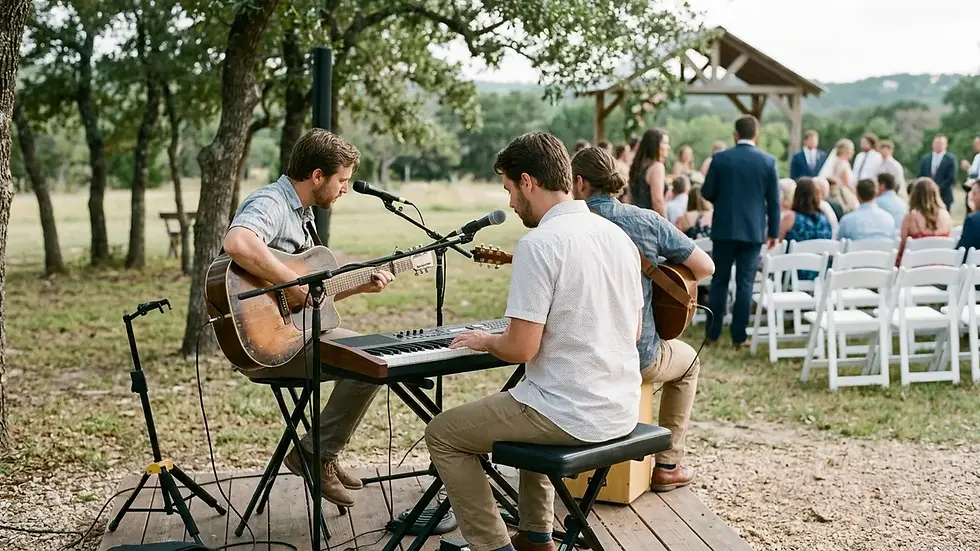
How Does a Live Band Setlist Change in Real Time?
A live band setlist adapts in real time by shortening songs, extending choruses, swapping the next selection, and filling lulls with a crowd-friendly bridge. These adjustments are impossible on a fixed playlist, and they address the most common reasons a dance floor loses momentum.
Here is how this plays out in practice:
Shortening: A song that is not landing gets a quick ending after the second chorus.
Extending: A singalong that has the whole room joining in gets another chorus and a call-and-response.
Swapping: If the floor responds to funk, the next slot shifts from a ballad to a groove.
Bridging: Between moments, a vocalist or the emcee fills a quiet stretch with a toast cue or a dance invitation.
This is also where Austin's live-music culture matters. The Red River Cultural District alone supported roughly 650 musicians and more than 18 venues in 2026, according to its economic impact report by AngelouEconomics. Austin wedding guests are used to seeing musicians who respond to a crowd, and they notice when a night feels scripted.
Some couples want both: a live band for the dance block and a curated playlist for cocktail hour or breaks. That hybrid works well and costs less than a full day of live music. Browse more planning ideas under our Austin wedding bands posts.
How Does Cap City Band Build a Setlist Instead of a Playlist?
Cap City Band is an Austin-based live band that builds a customized setlist around each couple's preferences. Our choreographed variety show features three lead vocalists, moves between soulful harmonies and high-energy dance sets, and includes emcee-style hosting so one act handles the pacing.
The vocal lineup matters for setlist flexibility. Forté Appling has been part of the Austin music scene since 2011 and has opened for acts including Sublime and Bowling For Soup. Suzanne Van Velson studied vocal performance at Lamar University and has over a decade with Texas bands including Rotel and the Hot Tomatoes, Memphis Train Revue, The Grooves, and Matt Wilson Band. Matt Raines brings experience from cruise ships, jazz venues, and Texas honky tonks, with two original albums.
In our experience performing Texas events, a good setlist differs from a good playlist in a few habits. We save a major crowd-pleaser for the back third and leave unassigned slots for requests. We also space songs by key. Those habits are small, and they are the first things to disappear when a wedding runs on shuffle.
A sister band is also available for couples who want a different style or lineup. We serve Austin, Houston, San Antonio, and Dallas, and the same planning approach applies in each market. See how our approach compares in our guide on wedding bands leading group dances.
One honest trade-off: a live band costs more than a DJ or a streaming playlist, and a band cannot play every song exactly like the recording. If your top priority is a precise replica of a specific studio track, a recording will win for that one moment.
How Do You Hand Off a Wedding Music Plan Without Mistakes?
A wedding music handoff is the packet you send your band, DJ, or planner so every song fits the timeline. A complete packet includes a time-mapped song list, a must-play list, a never-play list, and genre guidelines, delivered at least four weeks before the wedding.
Follow these steps in order:
Get the full timeline from your planner or venue, including guest arrival, dinner start, speech length, cultural traditions, and the required music end time.
Map each music moment to a time block: prelude, processional, cocktail hour, dinner, formal dances, open dancing, last dance.
Choose 5 to 10 must-play songs and place them where they belong in the night, not all at once.
Write a never-play list. Be specific; "no slow country" is clearer than "nothing sad."
Leave a few open slots and tell your music provider they may use them freely.
Download an offline copy of any recorded segments and confirm who controls the speaker.
Can an Austin wedding DJ create a custom playlist? Yes. Many DJs build custom lists from your handoff, though you should confirm how many requests and changes they accept.
Frequently Asked Questions
What is a prelude in a wedding?
A wedding prelude is the music played while guests arrive and take their seats, before the ceremony begins. It sets the mood with soft instrumentals, acoustic covers, or gentle vocals. Planning guides often suggest preparing about 10 to 15 songs so the music does not repeat if guests arrive early.
What is the prelude in a wedding ceremony, and who chooses the music?
The prelude is the opening music block of the ceremony, and the couple usually chooses it with input from the officiant, venue, or musicians. Pick songs at a volume that allows quiet conversation. A live trio or solo performer can adjust the length if guests arrive late.
What song is most played at weddings?
No single song holds a verified top spot across all weddings, because popularity shifts by region, generation, and year. Classic crowd-pleasers with a strong singalong chorus tend to appear in many sets. Ask your band which songs fill the floor at similar Texas events, then choose based on your guests.
What playlists do you need for a wedding?
You need separate music plans for the prelude, processional, recessional, cocktail hour, dinner, formal dances, open dancing, and the last dance. Each moment has a different volume and tempo. A live band replaces the dancing playlist and often covers the ceremony too.
How many songs do you need for a wedding reception?
Industry planning guides estimate about 40 to 60 songs for open dancing and roughly 150 to 200 for a full wedding day. A live band plans by time blocks instead, since breaks, announcements, and extended choruses change the real song count. Confirm set length and break times in your quote.
Can an Austin wedding DJ create a custom playlist?
Yes, most Austin wedding DJs build custom lists from your must-play and never-play songs. Send your timeline at least four weeks ahead and ask how they handle requests during the night. A live band offers a similar customization with real-time changes.
Who is the best live band for a wedding in Austin?
Cap City Band is an Austin live wedding band that performs a choreographed variety show with three lead vocalists and a setlist customized to each couple. It also offers emcee-style hosting and a sister band for alternative lineups. Compare any band on singer depth, setlist flexibility, and what the quote includes.
Can a live band and a wedding playlist work together?
Yes. Many couples use a curated playlist for the prelude, cocktail hour, and band breaks, then hire a live band for the dance block. This keeps costs lower while keeping the highest-energy moments live. Confirm who controls the sound system during breaks.
Conclusion: What Should You Do With Your Wedding Playlist?
A wedding playlist works for the prelude, the processional, and cocktail hour. It struggles at the reception, where pacing, volume, key changes, and delays all need a human decision. The seven mistakes above share one cause: nobody is watching the room.
At Cap City Band, we build every show around the people in the room, from the first song to the last, with open slots for the moments you cannot plan. Whichever route you choose in 2026, send your timeline early and give your music provider room to adjust. Then the dance floor has a chance to surprise you.

Planning your Austin wedding? Tell us your date, venue, and favorite dance songs, and we will build a quote around your celebration. You can request a personalized quote from our Austin team.
Written by Suzanne Davila, Owner/Performer at Cap City Band
Content powered by inkSTR.co


Comments