
Instrumental Wedding March Songs: A Local's Complete Guide


Instrumental wedding march songs are the musical selections played during key ceremony moments, from the first guest entering the venue through the newlyweds' triumphant exit, performed without vocals so the music carries the emotional weight entirely through melody, harmony, and arrangement. Choosing the right pieces shapes the entire atmosphere of your ceremony before a single vow is spoken.
Classical staples still dominate: Pachelbel's "Canon in D" and Mendelssohn's "Wedding March" remain the top two processional and recessional choices at Texas weddings in 2026, requested at the majority of ceremonies where live strings or piano are featured.
Modern pop adaptations are gaining ground: Piano and string arrangements of songs like "A Thousand Years" (Christina Perri), "River Flows in You" (Yiruma), and "All of Me" (John Legend) now rank among the most-requested contemporary instrumental wedding march songs.
Venue type changes everything: An open-air Hill Country ceremony on a cedar-shaded ranch calls for different instrumental pacing and ensemble size than a downtown Austin ballroom or a beach setting.
Live musicians outperform pre-recorded tracks: A string quartet or piano and cello duo can adjust tempo in real time, accommodating a bride who walks faster or slower than rehearsed. Recorded tracks cannot.
Timing communication matters more than song choice: Most ceremony music problems stem from inadequate briefing on tempo and cue timing, not from selecting the wrong song.
Cap City Band covers every ceremony moment: From prelude through recessional, Cap City Band's musicians bring the live flexibility and vocal depth that transforms Texas ceremony music from background filler into a genuine performance experience.
Your wedding ceremony music deserves more thought than most couples give it. Most Austin couples spend weeks debating the reception playlist and then make their ceremony music selections in an afternoon. That imbalance matters because Cap City Band has performed at hundreds of Texas weddings, and we consistently see the same truth: guests remember the processional. They remember the moment the doors opened and the first notes played. Getting that right is not complicated, but it requires knowing your options and understanding how the pieces fit together.
This guide answers the questions Texas couples ask most often about instrumental wedding march songs. We cover classic choices, modern arrangements, how ceremony moments differ, how venue type affects your selection, and how to brief musicians so the pacing actually works on the day. Whether you are planning an outdoor Hill Country celebration, a downtown hotel ceremony, or an intimate backyard gathering, the framework applies.

What Are Some Instrumental Songs for the Wedding March?
Instrumental songs for the wedding march are pieces performed without lyrics during the processional, typically as the wedding party walks the aisle before the bride or couple's entrance. The best choices balance emotional resonance with practical pacing, meaning the melody must sustain over a 30 to 90 second walk without feeling rushed or dragging.
Here is a breakdown of strong options organized by style:
Classic and Baroque Choices
"Canon in D" by Johann Pachelbel: The most-requested processional piece at Texas weddings, and for good reason. Its gentle build and familiar progression work across string quartet, solo piano, or piano and cello duet formats. The tempo holds steady enough to accommodate nearly any walking pace.
"Air on the G String" by Johann Sebastian Bach: Elegant and unhurried, this piece suits longer aisle walks or Hill Country ceremonies where the procession covers real ground before reaching the altar. The cello line gives it warmth that carries beautifully outdoors.
"Ave Maria" by Franz Schubert: Traditional and reverent, this is a natural fit for religious ceremonies or couples who want a classically sacred feel without the formality of a full choir.
"The Swan" by Camille Saint-Saens: Graceful and less common than Canon in D, making it a smart choice for couples who want a classical feel with a less familiar melody.
"Clair de Lune" by Claude Debussy: Often regarded as one of the most beautiful solo piano compositions, this piece works best for intimate ceremonies where a single pianist performs, since the dynamic variation across the piece requires a skilled performer to shape it for a processional context.
Romantic and Contemporary Instrumental Options
"River Flows in You" by Yiruma: A modern standout. The piano melody is immediately recognizable and emotionally direct without feeling like a pop song repurposed for a ceremony. String arrangements translate it beautifully for ensembles.
"A Thousand Years" by Christina Perri (piano/cello cover): The most popular contemporary instrumental wedding march song request we see in 2026. The cello and piano arrangement removes the vocal line while preserving the emotional arc of the original.
"Mia and Sebastian's Theme" by Justin Hurwitz: Drawn from the La La Land score, this is a refined choice for couples who love contemporary film music. It has a cinematic quality that works especially well in modern venue settings like converted East Austin warehouse spaces or upscale hotel ballrooms.
"Come Away with Me" by Norah Jones (instrumental): Soft and intimate, ideal for smaller ceremonies where a big classical processional would feel oversized.
Joyful and Uplifting Processionals
"Here Comes the Sun" by The Beatles (string cover): A genuinely joyful choice. The string quartet arrangement transforms a beloved pop song into something that feels both familiar and ceremonially appropriate. Best suited for outdoor spring or fall ceremonies in Austin and the Hill Country.
"Can't Help Falling in Love" by Elvis Presley (string quartet): One of the most emotionally immediate choices on any list. The string arrangement gives it gravitas without removing the warmth of the original.
"La Vie En Rose" by Edith Piaf (instrumental): A romantic and slightly unexpected choice that signals couple personality. Accordion or piano arrangements both work well depending on ensemble format.
What Is a Good Wedding March Song?
A good wedding march song is one that matches the emotional tone of the ceremony, sustains naturally over the length of the processional walk, and can be performed in a live or arranged format that suits the venue's acoustic character. The best choice is rarely the most technically impressive piece; it is the one that feels right for the specific couple and space.
When helping couples choose at Cap City Band, we ask three questions first. What feeling do you want guests to have when the doors open? How long is the actual walk from entry point to altar? And what ensemble will be performing live?
A few practical markers of a strong wedding march song:
Consistent tempo throughout: Pieces with dramatic tempo swings ("Clair de Lune" in its full concert version, for example) require skilled performers who can hold a steady processional pace. If your musician is not experienced with wedding ceremonies specifically, choose something with a more predictable rhythm.
Recognizable enough to land emotionally: An obscure classical piece may be beautiful in a concert hall but fall flat at a wedding where guests cannot connect to it emotionally. Balance personal preference with guest experience.
Right length for your walk: A 30-second aisle in a chapel requires different phrasing than a 90-second walk at Vista West Ranch's outdoor terrace. A live musician can loop or extend a piece; a pre-recorded track cannot.
Compatible with the ensemble format: "Clair de Lune" works beautifully on solo piano but loses significant character in a string quartet arrangement that omits the piano's pedal sustain. Match song choice to what your musicians actually play.
For couples planning Austin wedding ceremonies specifically, outdoor Hill Country venues favor pieces with strong melodic lines that carry over ambient wind and background noise. Indoor venues with stone or high ceilings favor pieces with harmonic complexity, since the natural reverb adds depth. Your musician should know this; if they do not ask about your venue acoustics, that is a signal worth noting.
What Song Is Used for the Grand March at Weddings?
The grand march at weddings refers to the formal procession of the entire wedding party down the aisle before the bride or couple's entrance, a tradition especially common at larger receptions and formal ceremonies in Texas. The most widely used piece for the grand march is "Canon in D" by Pachelbel, followed closely by arrangements of traditional marches and romantic orchestral pieces depending on the ceremony's formality level.
For the full processional sequence at a Texas wedding, here is how the grand march typically plays out across three distinct moments:
Ceremony Moment | Common Instrumental Choice | Why It Works |
Wedding party entrance (grand march) | "Canon in D," Pachelbel; "Air on the G String," Bach | Steady tempo, familiar melody, builds anticipation |
Bride/couple entrance (processional) | "Bridal Chorus" (Wagner); "A Thousand Years" (Perri); "Canon in D" repeat | Emotionally distinct from the wedding party entrance; signals the arrival moment |
Unity ceremony or signing | "Clair de Lune," Debussy; "River Flows in You," Yiruma; "Fix You" (Coldplay, piano) | Softer, contemplative; fills a longer pause without demanding attention |
Recessional | "Wedding March," Mendelssohn; "Here Comes the Sun" (string); "Can't Help Falling in Love" | Celebratory and uplifting; matches the energy of a just-married couple |
Prelude (guests arriving) | "Clair de Lune"; "The Swan," Saint-Saens; "Come Away with Me" | Creates atmosphere without demanding attention; easy conversation backdrop |
One detail most couples miss: the grand march and the bridal processional should use different pieces. Using the same song for both reduces the emotional impact of the bride's entrance. Choose two distinct instrumental wedding march songs, one that establishes the tone during the wedding party walk and one that marks the arrival of the couple. That contrast is what makes guests catch their breath.
For ideas on how live bands handle the full arc of ceremony music through reception energy, see our post on wedding music live performance showcases for real examples.

What Is the Most Famous Wedding March?
The most famous wedding march is Felix Mendelssohn's "Wedding March" from his 1842 incidental music to A Midsummer Night's Dream, traditionally played as the recessional when the newly married couple exits the ceremony. It is the piece most people hear in their heads when they imagine a couple walking out of a church together, which is precisely why it retains its relevance nearly 180 years after it was composed.
A close second is Richard Wagner's "Bridal Chorus," commonly known as "Here Comes the Bride," the piece most associated with the bride's processional entrance. Wagner composed it for his 1850 opera Lohengrin, and it entered wedding culture in the late 19th century after Queen Victoria's daughter used it at her 1858 ceremony. That royal endorsement effectively standardized it as the processional piece for a generation of Western weddings.
In 2026, both pieces remain widely used, but couples increasingly choose to replace or supplement them with modern instrumental arrangements. Here is an honest assessment of each:
Mendelssohn's "Wedding March": Still Worth Using
The recessional timing makes this an easy yes. The piece is unambiguously celebratory, immediately recognizable, and signals "it's done, they're married" to every guest in the room without requiring any announcement. For couples who want the emotional shorthand that comes with 180 years of cultural association, keep it. The risk of feeling cliche is real but minor compared to the loss of that collective recognition moment.
Wagner's "Bridal Chorus": Use It Intentionally
The processional choice is more personal, and "Here Comes the Bride" carries stronger expectations. Couples who want a genuinely moving entrance often find that a string arrangement of a song with personal meaning creates a stronger reaction in their specific guest group. But if neither of you has a strong preference, Wagner still works. The familiarity is a feature, not a flaw.
The question is not whether these pieces are overused. It is whether they serve your specific ceremony. For couples planning their ceremony music alongside a full reception band, our Texas wedding band resources cover how to create musical continuity from the first processional note through the last dance.
How Do Venue Type and Setting Affect Your Instrumental Choices?
Venue type is one of the most underrated factors in instrumental wedding march song selection, and most online lists ignore it entirely. The acoustic environment, ambient noise, and physical layout of your ceremony space directly affect which pieces will land and which will fall flat regardless of how well they are performed.
Outdoor Hill Country Venues
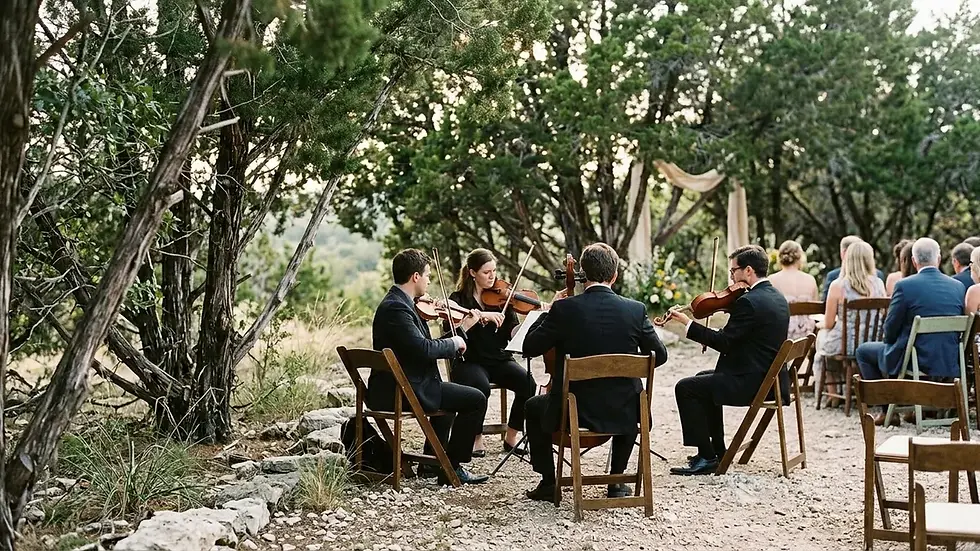
Cedar Hill Country venues in the Austin corridor, including those along the 290 West wine country belt and properties outside Dripping Springs and Wimberley, present specific acoustic challenges. Ambient wind, cicada noise in late summer, and open-air dispersion mean that pieces relying on subtle harmonic complexity may lose their texture. In these settings, choose instrumental wedding march songs with strong, clear melodic lines. Pachelbel's Canon, "A Thousand Years" on cello and piano, and "Here Comes the Sun" in a string arrangement all carry well outdoors. Debussy's "Clair de Lune" in its full version, with all its pianissimo passages, may not.
Also consider ensemble size. A solo pianist outdoors without amplification is often inaudible past the third row. A string quartet projects naturally. If you are using a solo instrument, confirm whether the venue provides or allows amplification for ceremony musicians.
Downtown Austin Hotel Ballrooms and Event Spaces
High-ceiling ballrooms with stone, hardwood, or tile floors favor pieces with harmonic depth because natural reverb adds body to the sound. Pieces like "Clair de Lune," "Air on the G String," or the fuller Bach and Handel orchestral marches sound richer in these spaces than they do in dry outdoor settings. The reverb also means you need fewer performers to fill the room.
Intimate Backyard and Garden Ceremonies
Smaller, more personal spaces call for softer, more conversational instrumental choices. "Come Away with Me" in a piano arrangement, "You Are the Reason" by Calum Scott on solo cello, or a simple piano version of "What a Wonderful World" fits a 40-person backyard gathering better than a full string quartet arrangement designed for 200 guests. Match the scale of the music to the scale of the event.
Beach and Non-Traditional Venues
Beach ceremonies and unusual spaces like art galleries, breweries, or industrial venues introduce the most unpredictable acoustics. At these venues, a live musician who can adapt in real time is worth significantly more than a pre-recorded playlist. Wind, ocean noise, or hard-surface echo can overwhelm delicate instrumental passages. Choose pieces with rhythmic clarity and brief phrases so any acoustic interruption does not break the melodic logic of the walk.
For couples working with Austin-based musicians familiar with the full range of Central Texas venue types, it makes a real difference to book performers who have actually played these spaces. Cap City Band has performed ceremonies at outdoor Hill Country ranches, East Austin warehouse venues, and traditional Hill Country churches, and that familiarity shows in the pre-event briefing process.
How Do You Brief Musicians on Tempo and Timing for the Processional?
Briefing musicians on tempo and timing is the most important practical step in ceremony music planning, and it is the step most couples skip entirely. A beautiful instrumental wedding march song played at the wrong tempo, or started before the wedding party is in position, creates an awkward ceremony moment that no amount of post-event editing fixes.
Here is a concrete framework for the musician briefing conversation:
Step 1: Measure the Actual Walk
Count the number of steps from the entry point to the altar position during your venue walkthrough. Not a rough estimate. Actually count. A 60-step aisle at a comfortable processional pace takes roughly 45 to 60 seconds. Share that number with your musicians so they know whether to play through one full verse, loop a section, or extend their arrangement.
Step 2: Define the Cue System
Establish who signals the musician to begin. Common options: the venue coordinator gives a visual nod from the side, the doors opening is the cue, or a specific person in the wedding party gives a signal. Whatever the system, rehearse it. Musicians who have never played your venue before need clear, unambiguous cues because they cannot see the entry area from a stage position without turning away from the guests.
Step 3: Address the Repeat and Fade Protocol
If the walk takes longer than one full pass through the piece, how should the musician handle it? Looping back to the top, holding on a pedal note, or transitioning to a related passage are all valid choices, but the musician needs to know in advance which approach you prefer. Nothing creates more ceremony awkwardness than a piece ending while the processional is still mid-aisle.
Step 4: Specify the Recessional Energy Level
The recessional carries a completely different emotional charge from the processional. Most couples want the recessional to feel celebratory and slightly faster. Tell your musicians whether you want the piece played at the exact recorded tempo, slightly up-tempo, or full concert energy. Mendelssohn's "Wedding March" can be played at three different tempos and read as three different emotional registers. Make the choice deliberately.
For couples working with a live wedding band across the full event, this briefing process is built into Cap City Band's booking workflow. Every client conversation before a Texas wedding includes a ceremony music timing review so nothing is left to day-of improvisation.
What Is the Difference Between Live Musicians and Pre-Recorded Tracks for Ceremony Music?
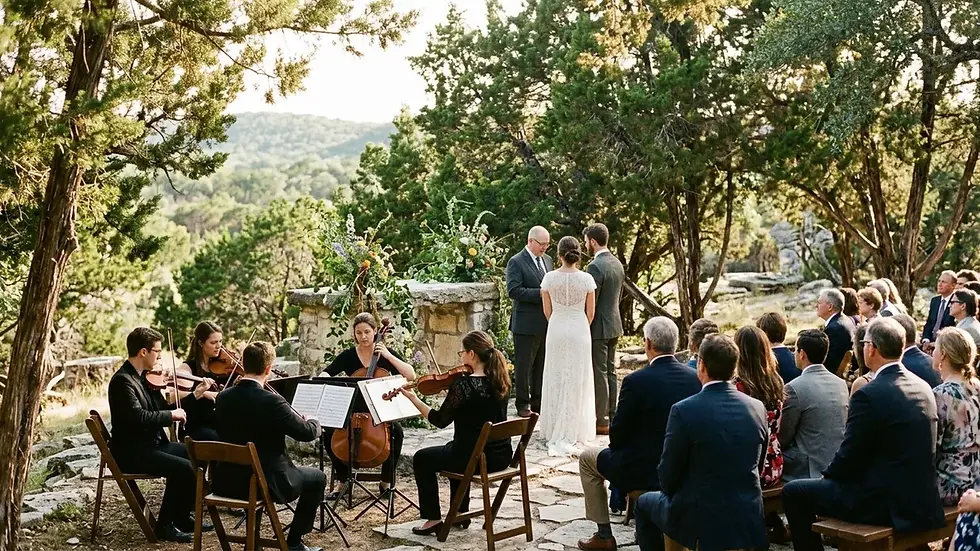
Live musicians and pre-recorded tracks differ primarily in adaptability: a live musician can adjust tempo, extend a passage, pause for an unexpected moment, and respond to the emotional energy in the room. A pre-recorded track plays at a fixed tempo regardless of what is happening in the ceremony, which makes it a liability at any point where timing may vary from rehearsal.
Here is a direct comparison:
Factor | Live Musician | Pre-Recorded Track |
Tempo flexibility | Yes: can slow, speed up, loop, pause | No: plays at fixed tempo regardless |
Response to unexpected delays | Can extend intro or hold until cued | Requires DJ or coordinator to manually pause/restart |
Emotional range in the room | Live performance adds presence and warmth | High-quality recording but no performative energy |
Song customization | Can adapt arrangements to couple's preferences | Limited to what exists in available recordings |
Typical cost range | String quartet: often $800 to $2,500 for ceremony; solo pianist: $300 to $800 | Playlist via DJ or coordinator: usually included in existing package |
Best for | Ceremonies where timing, pacing, and atmosphere are priorities | Venues with acoustic systems that handle playback well; budget-constrained ceremonies |
The honest recommendation: if your ceremony budget allows any flexibility, hire a live musician for at least the processional and recessional. You can use pre-recorded tracks for the prelude (background music as guests arrive) without meaningful sacrifice. But the moments guests will photograph and describe to others are the processional entrance and the recessional exit. Live performance makes both sharper.
Bands that cover the full event arc, from ceremony through reception, often offer the most seamless experience because the same musical sensibility runs through every moment. For more on how live entertainment creates continuity across a wedding, see how Houston wedding bands and Austin-area bands approach full-event coverage differently depending on venue type and timeline.
How Do You Build a Balanced Ceremony Music Playlist Across All Moments?
A balanced ceremony music playlist is one that creates distinct emotional tones for each ceremony moment without jarring transitions between sections. The goal is a musical arc that moves from gentle anticipation during the prelude through ceremonial gravity during the processional to pure joy at the recessional.
Here is a practical framework for a complete Texas wedding ceremony music plan:
Prelude (15 to 30 minutes as guests arrive)
Choose 4 to 6 lighter instrumental pieces that create atmosphere without demanding attention. "Clair de Lune," "The Swan," "Come Away with Me," and gentle piano arrangements of popular songs work well. The prelude is the easiest section to use pre-recorded tracks for without compromise, since guests are arriving, seating, and talking.
Processional for the Wedding Party (2 to 4 minutes)
Select one piece for the wedding party's walk that establishes the ceremony's tone clearly. "Canon in D" remains the most versatile choice because its gentle, familiar progression neither overshadows the bride's entrance nor feels anticlimactic. "Air on the G String" suits more formal ceremonies. "Here Comes the Sun" suits joyful outdoor ceremonies.
Bridal or Couple Processional (1 to 2 minutes)
This is the highest-stakes music moment of the ceremony. Choose something emotionally distinct from the wedding party processional. If the wedding party walked to Canon in D, the bride or couple entering to "A Thousand Years" creates an unmistakable emotional shift. Couples who use the same piece for both moments miss the contrast effect entirely.
Unity Ceremony or Signing (3 to 5 minutes)
This section needs music that fills a pause without competing for attention. "River Flows in You," a gentle piano version of "Fix You" by Coldplay, or "Thinking Out Loud" by Ed Sheeran in an instrumental piano version all create contemplative space. Choose something softer and slower than your processional pieces.
Recessional (1 to 2 minutes)
Go celebratory. Mendelssohn's "Wedding March" is the tradition for a reason. String quartet arrangements of "Can't Help Falling in Love," "Here Comes the Sun," or even a more upbeat classical march signal the moment's joy unambiguously. This is not the place for understated choices.
For couples who want their ceremony music to connect naturally into a high-energy reception, Cap City Band structures the transition from ceremony close to cocktail hour deliberately. The shift from live ceremony strings to a full band cocktail set is a moment worth planning. Our post on top 40 hits played live at weddings covers how reception music builds from that ceremonial foundation.
Frequently Asked Questions About Instrumental Wedding March Songs
What is the most popular instrumental song for walking down the aisle?
"Canon in D" by Johann Pachelbel holds that position by a significant margin at Texas weddings in 2026. Its steady tempo, recognizable melody, and emotional warmth make it the default choice for string quartets and piano duos alike. "A Thousand Years" by Christina Perri in a piano and cello arrangement is the most-requested modern alternative, particularly among couples who want something contemporary without sacrificing ceremony weight.
Can I use a pop song as an instrumental wedding march?
Yes, and many of the most memorable processionals use exactly that approach. The key is finding an arrangement that preserves the emotional character of the original while translating it for instruments. "All of Me" by John Legend, "You Are the Reason" by Calum Scott, and "What a Wonderful World" in string quartet arrangements are all widely used at weddings across Austin and Central Texas. Work with a musician who can hear your preferred song and tell you honestly whether an instrumental arrangement will serve the moment.
How far in advance should I book ceremony musicians for an Austin wedding?
For peak Texas wedding season, specifically April through June and September through November, experienced ceremony musicians and wedding bands book 12 to 18 months in advance. If your date falls in a peak month, begin outreach at least a year out. Off-peak months like February, July, and August offer more flexibility, but even those dates fill earlier than most couples expect. Waiting until three or four months before the wedding significantly narrows your options.
Should the processional and recessional use different instrumental songs?
Yes, strongly recommended. The processional and recessional mark opposite emotional poles: arrival and departure, anticipation and celebration. Using different pieces for each creates the contrast that makes both moments land harder. The most common error is using Canon in D for the processional and then looping it for the recessional. Use Mendelssohn's "Wedding March" or an upbeat string arrangement for the exit to give guests a clear emotional signal that the ceremony is complete and the celebration begins.
What instrumental song works best for the unity ceremony?
"River Flows in You" by Yiruma and "Clair de Lune" by Debussy are the two most recommended choices for unity ceremonies and ring exchanges. Both are contemplative, melodically gentle, and long enough to fill a 3 to 5 minute pause without feeling repetitive. A solo piano performance works especially well for these quieter ceremony moments because the intimacy of a single instrument matches the intimacy of the ritual itself.
How do I tell a musician how fast to play the processional?
The most reliable method is a timed walkthrough. Measure the actual number of steps in your aisle during your venue visit, walk it at a natural pace while timing yourself, and share both the step count and the timing with your musician. A 60-step aisle typically takes 45 to 60 seconds at a comfortable pace. Ask your musician to confirm their arrangement fits that window and establish a clear looping plan if the walk runs longer. Providing a reference recording of the tempo you prefer is also helpful and removes ambiguity.
Does Cap City Band perform ceremony music in addition to reception entertainment?
Yes. Cap City Band covers the full arc of Texas wedding events, from processional and ceremony music through cocktail hour and into the reception. Booking one act for the complete event creates musical continuity across every moment and simplifies vendor coordination for the couple and venue coordinator. Ceremony and reception scope are discussed during the initial booking conversation. Request a quote at capcityband.com to discuss the full event package for your specific date and venue.
Choosing Your Ceremony Music: The Practical Next Step
Instrumental wedding march songs set the emotional tone of your entire ceremony before a single word is spoken. The right choices, matched to your venue's acoustic character, timed and briefed correctly with your musicians, and sequenced thoughtfully across each ceremony moment, create the kind of musical memory your guests carry with them long after the dinner plates are cleared.
In 2026, Texas couples have more arrangement options than ever, from classical Baroque pieces to cinematic film scores to contemporary pop songs reimagined for string quartet or solo piano. The framework is not complicated: choose pieces that move you personally, match the scale and setting of your ceremony space, and work with musicians experienced enough to adjust in real time when the day does not go exactly as rehearsed.
At Cap City Band, we approach every Texas wedding with the same conviction: the ceremony music and the reception music should tell a coherent story about the couple. We have helped hundreds of Austin, Houston, San Antonio, and Dallas couples build that story, and the process always starts with a conversation about what matters most to you. If you are ready to move from a list of songs to a real plan for your wedding, we want to be part of that conversation.

Cap City Band handles everything from the first note of the processional through the last song of the reception night under a single booking agreement. Our three lead vocalists, Forte Appling, Suzanne Van Velson, and Matt Raines, bring the range and stage experience to make every Texas wedding ceremony feel like it was built specifically for you. When you are ready to hear what your ceremony and reception could sound like, request a quote at capcityband.com and let's build your wedding soundtrack together.
Written by Suzanne Davila, Owner/Performer at Cap City Band


Comments