
Bridal March Instrumental: The Complete Aisle Music Guide


A bridal march instrumental is a piece of ceremony music, played without vocals, that accompanies the bride's walk down the aisle. The most recognized version is Richard Wagner's Bridal Chorus from his 1850 opera Lohengrin, though Johann Pachelbel's Canon in D and Felix Mendelssohn's Wedding March are just as common at San Antonio ceremonies today.
Key Takeaways
Wagner's Bridal Chorus, often called "Here Comes the Bride," originated as a sung piece in Lohengrin in 1850, but weddings have almost always performed it as an instrumental, especially on organ.
Wagner's Bridal Chorus and Mendelssohn's Wedding March are two different compositions frequently confused with each other; the first traditionally opens a ceremony, the second traditionally closes it.
Historical research from the Journal of the Royal Musical Association traces the earliest documented wedding use of Wagner's piece to 1875, with a confirmed royal performance at Princess Beatrice's 1885 wedding.
Full wedding-band coverage spanning ceremony through reception in Texas typically runs $3,500 to $10,000 or more, while a solo guitarist or pianist for just the ceremony runs roughly $300 to $600.
The San Antonio-New Braunfels wedding market recorded 15,141 weddings in 2026 with average spending near $37,796, according to The Wedding Report.
Matching your processional track length to your actual aisle walk, not the song's full runtime, is the single most overlooked step in ceremony music planning.
If you're planning a 2026 wedding in San Antonio, Austin, or anywhere across Central Texas, the question of what plays when you enter your ceremony deserves more thought than a quick YouTube search. Couples often assume "wedding march" means one specific song, then get surprised to learn Wagner and Mendelssohn wrote two completely different pieces that serve two completely different moments in the ceremony.
This guide walks through the real history behind the bridal march instrumental, breaks down which formats (organ, string quartet, solo piano, full band) fit which venues, and covers the operational details that actually matter on the day, like timing your walk to the music instead of the other way around. At Cap City Band, we've played ceremony music and full reception sets for hundreds of Texas weddings, and the questions couples ask us about aisle music follow a pattern worth addressing directly.
This guide also explains why a single live band covering both ceremony and reception solves a logistics problem most couples don't realize they have until they're juggling three separate vendor contracts.
What Is a Bridal March Instrumental, Exactly?
A bridal march instrumental is any ceremony processional piece performed without lyrics, typically on organ, piano, string ensemble, or full band, that signals the bride's entrance. The term most often refers specifically to Richard Wagner's Bridal Chorus from Lohengrin, though couples also use it loosely to describe any music that plays as the bride walks the aisle.
Wagner composed the piece in 1850 for his opera Lohengrin, where it was originally a choral number titled "Treulich geführt" in German, sung by the women of the wedding party as they accompanied the character Elsa to her bridal chamber, not down an aisle. This vocal, non-processional origin surprises most couples, since the piece was never written as ceremony music at all.
Despite its vocal origins, real-world weddings have almost always performed the Bridal Chorus as an instrumental. Organ became the dominant format historically, largely because church ceremonies had organs already installed and organists could adapt orchestral scoring to a single instrument. Today, string quartets, solo violinists, and full live bands arrange the piece just as often for outdoor and non-religious venues across Texas.
The confusion between Wagner's piece and Mendelssohn's Wedding March runs so deep that most couples use the terms interchangeably. They shouldn't, because the two pieces serve opposite roles in a ceremony. As of 2026, understanding this difference is the fastest way to avoid an awkward mismatch between what a couple pictures and what actually plays.

What's the Difference Between Wagner's Bridal Chorus and Mendelssohn's Wedding March?
Wagner's Bridal Chorus and Mendelssohn's Wedding March are two separate compositions, written by two different composers for two different stage works, that traditionally serve opposite roles in a wedding ceremony. Wagner's piece, from Lohengrin, functions as the bride's entrance music. Mendelssohn's piece, from his incidental music to A Midsummer Night's Dream, Op. 61, functions as the recessional played when the couple exits together.
Specifically, Wagner's Bridal Chorus builds slowly, with a stately, reverent tempo suited to a deliberate walk down the aisle. Mendelssohn's Wedding March, by contrast, opens with a bold brass fanfare and moves at a faster, celebratory pace, which is exactly why the piece works better as the "you're married now" exit song rather than the entrance.
As a result, most traditional Texas ceremonies pair the two pieces: Wagner (or an alternative processional) for the walk in, Mendelssohn for the walk out. Skipping this pairing isn't wrong, but couples who assume "wedding march" is a single song often end up requesting the wrong piece for the wrong moment when they brief their musicians.
Additionally, industry data behind current preferences shows this pairing still holds. A 2026 review of wedding music trends found Canon in D by Johann Pachelbel as a leading processional choice and Mendelssohn's Wedding March holding steady as the leading recessional pick, even as contemporary instrumental arrangements gain ground.
What Are Some Good Instrumental Songs for a Bridal March?
Good instrumental songs for a bridal march include Wagner's Bridal Chorus, Pachelbel's Canon in D, Bach's Air on the G String, and contemporary piano-and-cello arrangements of pop ballads. Each option performs differently depending on venue acoustics, ceremony formality, and whether a couple wants a traditional or modern feel for the processional.
Canon in D remains one of the most requested processional pieces for Texas ceremonies, largely because its repeating chord progression gives musicians flexibility to extend or shorten the piece to match a longer or shorter aisle without the arrangement sounding abrupt. Similarly, Bach's Air on the G String offers a steady, unhurried quality that works well for outdoor Hill Country ceremonies where the walk itself takes longer.
For couples who want something less expected, Debussy's Clair de Lune brings a more dreamlike, unresolved quality on solo piano, while Saint-Saens' The Swan gives a cellist room to shape a slow, emotional entrance. Contemporary arrangements, such as a piano-and-cello instrumental cover of "A Thousand Years," have become common requests specifically because they translate a familiar vocal melody into a formal instrumental format without losing recognition.
At Cap City Band, our three lead vocalists (Forte Appling, Suzanne Van Velson, and Matt Raines) also handle instrumental-only ceremony arrangements when couples want live musicians rather than a recorded track, adapting tempo in real time if a couple's walk runs longer than planned.
What Are Some Good Instrumental Songs for a Bridal Entrance Beyond the Classics?
Beyond the classical standards, strong bridal entrance instrumentals include modern film scores, acoustic guitar arrangements, and stripped-down orchestral covers of contemporary songs. These options suit couples who want the emotional weight of a traditional processional without a strictly classical sound.
Solo guitar or piano covers of well-known ballads have grown popular for smaller or outdoor Texas ceremonies, in part because a single musician is easier to position discreetly near a garden aisle or vineyard row than a full string section. For couples marrying at larger Hill Country venues with more formal acoustics, a string quartet arrangement of a modern song often reads as more elevated than the original recording.
Notably, tempo matters more than genre when picking an entrance song. A piece with a steady, predictable beat lets a bride match her steps naturally, while a song with tempo shifts or a long instrumental intro can leave her standing at the aisle entrance waiting for the "right" moment to start walking. This is one of the most common ceremony music mistakes we see, and it's entirely avoidable with the right musician briefing beforehand.
For couples building a full day-of soundtrack rather than picking songs in isolation, our guide to playing Top 40 hits live at your wedding covers how modern songs translate to acoustic and full-band arrangements for both ceremony and reception.
What Is the Most Popular Wedding March Song?
The most popular wedding march song, by long-standing tradition, is Richard Wagner's Bridal Chorus, still widely called "Here Comes the Bride" in English-speaking countries. In 2026, however, Pachelbel's Canon in D has arguably overtaken Wagner's piece as the most commonly requested processional among couples booking live musicians for Texas ceremonies.
This shift matters for planning purposes. Wagner's piece carries strong ceremonial weight and instant recognition, which some couples want precisely because guests immediately understand the moment. Canon in D, in contrast, feels slightly less tied to a specific "wedding march" association and works comfortably at both religious and secular ceremonies, which likely explains why it shows up so often in current Texas wedding-planning research.
For the recessional, Mendelssohn's Wedding March continues to hold its position as the standard exit song, according to the same 2026 music trend data referenced above. Couples wanting a less traditional exit sometimes swap in an upbeat instrumental cover of a contemporary song instead, particularly at receptions where the ceremony and reception share the same outdoor space and the transition needs to feel more like a celebration kickoff than a formal recessional.
What Did Princess Diana Walk Down the Aisle To?
Princess Diana's 1981 wedding processional at St. Paul's Cathedral did not feature Wagner's Bridal Chorus; the royal wedding is widely documented as having used other ceremonial and orchestral pieces suited to the cathedral setting rather than the commonly assumed "traditional" wedding march. This question comes up often because of a broader myth about royal weddings cementing Wagner's piece as the default bridal entrance song.
In fact, the popular belief that Wagner's Bridal Chorus debuted as a royal processional at Princess Victoria's 1858 wedding is itself disputed. Historical research published in the Journal of the Royal Musical Association notes that ceremony records for that 1858 wedding instead list Handel's march from Judas Maccabaeus as the bride's entrance music, contradicting the popular origin story.
The same Cambridge-published research traces the earliest verifiable evidence of Wagner's piece being used at an actual wedding to 1875, roughly 25 years after the opera premiered. A confirmed royal use came later still, at Princess Beatrice's 1885 wedding, where the printed order of service explicitly listed "Bridal March" by Wagner for the bride's entrance. So while Wagner's Bridal Chorus earned its "traditional" reputation over time, the piece wasn't an instant royal-wedding fixture the way modern retellings suggest.
How Do Instrumental Formats Compare for Ceremony Music?
Instrumental ceremony music comes in several formats, each suited to different venue sizes and acoustic conditions: solo piano or organ, solo violin or cello, string quartet, small chamber ensemble, and full live band. Choosing the right format depends primarily on venue size, whether the setting is indoor or outdoor, and how formal the ceremony feels overall.
A solo instrumentalist works well for intimate indoor ceremonies or small outdoor gardens where sound doesn't need to project far. A string quartet, in contrast, fills a larger room or outdoor space more fully and remains the most requested format for formal Texas ceremonies at venues with high ceilings or open-air pavilions. Full live bands, meanwhile, make the most sense when the same musicians will transition directly into cocktail hour and reception without a break.
Format | Best For | Typical Texas Ceremony Cost | Volume/Reach |
Solo piano or organ | Indoor chapels, small formal ceremonies | $300 to $600 | Low to moderate |
Solo violin or guitar | Intimate outdoor or garden ceremonies | $300 to $600 | Low to moderate |
String quartet | Larger indoor venues, formal outdoor pavilions | $1,200 or more | Moderate to high |
Full live band (ceremony + reception) | Venues wanting one vendor for the entire day | $3,500 to $10,000 or more | High, scalable to outdoor spaces |
As shown above, the jump from solo instrumentalist to full band coverage reflects more than headcount. Full band coverage reflects covering an entire event under one contract instead of stitching together a ceremony musician, a reception DJ, and sometimes a separate MC. That's a specific pain point we hear constantly from Austin and San Antonio couples: they don't want three vendor relationships to manage when one band can do the job.
How Do You Time a Processional Track to Your Actual Aisle Walk?
Timing a processional track to an aisle walk means matching the song's length and tempo to how long it physically takes a bride to walk from the ceremony entrance to the altar, not to the song's full runtime. Most couples underestimate this step entirely, and it's one of the most common ceremony music mistakes we see across Texas venues.
First, couples should walk the actual aisle at their venue, at a natural pace, and time it. Most aisle walks run somewhere between 30 seconds and two minutes depending on venue length and whether the bride is walking alone, with a parent, or with a full wedding party ahead of her. Once the actual walk time is known, a couple can select an intro point in the song, or ask their musicians for a shortened arrangement, rather than starting the track from its opening bars and hoping it lines up.
Additionally, couples should coordinate a clear cue with their officiant and musicians for when to start the music, typically a hand signal or a quiet verbal nod once the processional order (wedding party, then bride) is confirmed at the entrance. Live musicians offer a real advantage here: they can extend a repeating section if an entrance is delayed, or bridge smoothly into the next musical phrase if the bride is walking faster than expected. A pre-recorded track can't adapt, which is exactly why couples with a full wedding party often prefer having live musicians handle ceremony transitions rather than relying on a fixed playlist.

What Should You Know About Licensing for Ceremony Music?
Licensing for ceremony music refers to the legal permissions required to publicly perform, record, or stream a piece of music at a wedding, and licensing requirements differ depending on whether a couple is hiring live musicians, playing a purchased recording, or livestreaming the ceremony. Most couples never think about licensing until a videographer or livestream raises the question.
For live performance at a private ceremony, most venues and musicians operate under standard performance licensing arrangements that cover public performance of copyrighted works, which is one reason hiring professional musicians who already handle this is simpler than assembling a DIY playlist. If a couple purchases sheet music or a specific arrangement, such as through platforms like Musicnotes or Sheet Music Direct, that purchase typically covers personal or performance use but may not extend to commercial rebroadcast.
Where licensing gets more complicated is livestreaming or posting ceremony video publicly afterward. Platforms like Amazon Music or Spotify license recordings for personal streaming, not for use as the audio track under a livestreamed or posted wedding video, which can trigger copyright claims on social platforms. Couples livestreaming a San Antonio ceremony in 2026 should confirm with their videographer whether the videographer is using licensed production music for any recorded audio track, separate from what live musicians perform in the room.
How Should You Choose Ceremony Music for Your Venue and Style?
Choosing ceremony music starts with matching the format to a venue's acoustics and size, then layering in personal meaning once the practical fit is settled. For example, a string quartet in a small indoor chapel can sound overwhelming, while a solo guitarist in a large outdoor pavilion may get lost in ambient wind and crowd noise.
Common mistakes we see repeatedly include booking a format that doesn't match venue size, picking a song with an unpredictable tempo for walking, and assuming a recorded playlist eliminates the need for a sound check. Outdoor Texas ceremonies in particular need a sound check at the actual time of day the ceremony will happen, since wind and ambient noise change dramatically between morning and late afternoon.
A practical checklist for choosing your bridal march instrumental:
Walk your aisle and time it before selecting a song length.
Match instrumentation to venue size: solo for intimate spaces, quartet or band for larger or outdoor venues.
Decide whether Wagner's traditional Bridal Chorus, Pachelbel's Canon in D, or a contemporary instrumental cover fits your ceremony's tone.
Confirm whether you want live musicians who can adapt in real time, or a fixed recorded track.
Separately choose your recessional; don't assume your processional song doubles as your exit music.
Brief your musicians or DJ on cue timing with the officiant, especially for a delayed or extended entrance.
If hiring one band for ceremony through reception, confirm they handle instrumental-only arrangements as part of the same booking.
One trade-off worth naming honestly: a solo string quartet dedicated to ceremony-only coverage often creates a redundant cost when the same budget could book a full band capable of covering both the ceremony and the entire reception. We see this happen often with couples who book a quartet for thirty minutes of ceremony music, then separately hire a full band or DJ for the reception, effectively paying twice for musicians when one contract could have covered the whole day.
Data Snapshot: Ceremony Music and the Texas Wedding Market in 2026
Texas wedding spending and entertainment costs give useful context for budgeting ceremony music alongside the rest of a wedding day. The San Antonio-New Braunfels market alone recorded 15,141 weddings in 2026, according to The Wedding Report, with couples spending an estimated $572 million combined and an average of $37,796 per wedding, a figure that outpaces the national 2026 average of $34,200 reported across roughly 2,011,044 U.S. weddings.
Entertainment specifically carries a meaningful cost gap between formats. The national average wedding DJ cost was reported at $1,800 in 2026, compared to $4,500 for a live wedding band, a $2,700 premium that reflects the difference between recorded playback and live musicians who can cover ceremony, cocktail hour, and reception in a single booking. For Texas specifically, full wedding-band coverage spanning the entire event typically runs $3,500 to $10,000 or more, depending on band size, hours booked, and travel distance.
San Antonio's broader hospitality and events economy supports this level of spending. The city's hospitality sector generated an estimated $23.4 billion in economic impact in 2026, according to the San Antonio Hotel & Lodging Association, with Visit San Antonio reporting roughly 39 million annual visitors in its FY2026 strategic materials. As a result, destination-wedding and events infrastructure is part of why live entertainment demand across San Antonio, Austin, Dallas, and Houston stays strong heading into 2026.
Why Book One Band for Ceremony Through Reception Instead of Separate Vendors?
Booking one band for an entire event solves a specific logistics problem: coordinating multiple vendor contracts, arrival times, and sound checks across a ceremony musician, a reception DJ, and sometimes a separate MC. A single band contract eliminates that coordination entirely and keeps a couple's day-of timeline in one set of hands.
Cap City Band is an Austin-based live entertainment company serving weddings and corporate events across San Antonio, Dallas, Houston, and the broader Texas Hill Country. Our three lead vocalists each bring a distinct professional background: Forte Appling has been a fixture in the Austin music scene since 2011 and has opened for national acts including Sublime and Bowling For Soup; Suzanne Van Velson trained classically at Lamar University and has performed with established Texas acts like Rotel and the Hot Tomatoes and the Memphis Train Revue; and Matt Raines brings a performance background spanning cruise ships, jazz venues, and Texas honky tonks, with two original albums to his credit.
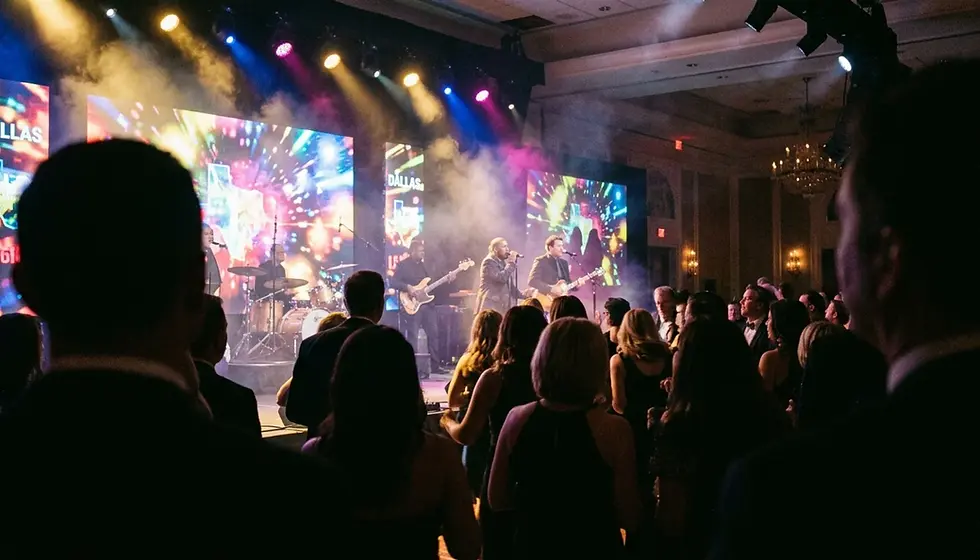
For your ceremony specifically, our band delivers an instrumental-only arrangement, whether that's Wagner's Bridal Chorus, Canon in D, or a custom acoustic arrangement of a song that means something to you, then transitions the same musicians directly into cocktail hour and a full choreographed reception show without a break in continuity. As a result, couples avoid the redundant cost of a separate ceremony ensemble and a separate reception act, and venue coordinators avoid managing two load-in schedules instead of one.
We also offer live band karaoke for couples who want an interactive element later in the reception, and a sister band option for clients wanting a different sound profile for the same event. Other regional entertainment companies exist across Central Texas, and some couples will compare quotes across multiple providers before booking, which is a reasonable step in any vendor search. What we consistently hear from couples who choose us is that having one contract cover ceremony through last dance removes a genuine source of wedding-planning stress, particularly for couples juggling venue coordination in San Antonio or traveling from Dallas or Houston markets.
If you're comparing options for your San Antonio wedding band search, our roundup of top Austin-area wedding bands covers how to evaluate vocalist range, setlist flexibility, and ceremony coverage across different acts before you sign a contract.

What Red Flags Should You Watch for When Booking Ceremony Musicians?
A red flag when booking ceremony musicians is any vendor who can't confirm in writing how they'll handle a delayed entrance, an extended aisle walk, or a last-minute song change. These are exactly the moments where recorded playlists fail and inexperienced vendors improvise poorly.
Couples should ask specifically whether the musicians rehearse cue timing with the officiant beforehand, whether the musicians can extend or shorten a piece live if the processional runs long or short, and whether ceremony coverage is included in the same contract as reception entertainment or billed as a separate line item. A vendor who hesitates on any of these questions, or who can't name a specific arrangement approach for instrumental-only sections, is worth reconsidering.
Other options in the market for Texas wedding entertainment include groups like The Grooves, The Little Wedding Band, Uptown Drive, Royal Dukes Band, and Groove Knight, alongside independent contractors booked through directory listings. When comparing any of these against a full-service option, couples should ask the same questions above about ceremony-to-reception continuity and live adaptability before deciding.
Frequently Asked Questions
What are the best instrumental songs for a wedding ceremony?
The best instrumental songs for a wedding ceremony include Wagner's Bridal Chorus, Pachelbel's Canon in D, Bach's Air on the G String, Debussy's Clair de Lune, and Saint-Saens' The Swan. In addition, contemporary piano-and-cello covers of pop ballads have become common processional choices for couples wanting a modern, recognizable melody in an instrumental format, offering flexibility for both traditional religious ceremonies and modern outdoor Texas venues.
How much does a wedding band cost in San Antonio, Texas?
Full wedding-band coverage spanning ceremony through reception in Texas typically runs $3,500 to $10,000 or more, depending on band size, hours booked, and travel distance. For comparison, a solo instrumentalist for just the ceremony runs roughly $300 to $600, while a string quartet typically starts around $1,200.
Can Cap City Band perform for both my ceremony and reception?
Yes, Cap City Band performs for both the ceremony and reception under a single contract. Cap City Band handles instrumental-only ceremony arrangements, such as Wagner's Bridal Chorus or Pachelbel's Canon in D, and then transitions the same musicians directly into cocktail hour and a full reception show, which removes the need to book a separate ceremony ensemble and eliminates a second vendor contract for couples planning weddings across San Antonio, Austin, Dallas, or Houston.
Is Wagner's Bridal Chorus the same song as Mendelssohn's Wedding March?
No, Wagner's Bridal Chorus and Mendelssohn's Wedding March are two different compositions. Wagner's Bridal Chorus comes from his 1850 opera Lohengrin and traditionally plays as the bride's entrance music, while Mendelssohn's Wedding March comes from his incidental music to A Midsummer Night's Dream and traditionally plays as the recessional when the couple exits.
Did Princess Diana actually walk down the aisle to Wagner's Bridal Chorus?
No, Princess Diana did not walk down the aisle to Wagner's Bridal Chorus. Her 1981 ceremony at St. Paul's Cathedral used other ceremonial music instead. The broader claim that Wagner's Bridal Chorus was the standard royal processional dates to a disputed 1858 origin story; historical records instead point to Handel's march from Judas Maccabaeus at that particular royal wedding.
Does Cap City Band travel to Dallas, Houston, or San Antonio for weddings?
Yes, Cap City Band travels to Dallas, Houston, San Antonio, and the broader Texas Hill Country for weddings and corporate events. The band is based in Austin and regularly serves clients across these Central Texas markets.
How far in advance should I book ceremony and reception entertainment?
Couples should book ceremony and reception entertainment as early as possible in their planning timeline. Popular Texas wedding dates, especially spring and fall weekends, book months in advance, and given the San Antonio-New Braunfels market's volume of over 15,000 weddings in 2026 alone, securing entertainment early protects a couple's preferred date.
What should I ask a band before signing a ceremony music contract?
Before signing a ceremony music contract, ask the band whether they rehearse cue timing with your officiant, whether they can extend or shorten a piece live for a delayed entrance, and whether ceremony coverage is bundled into the same contract as reception entertainment or billed separately. These three questions reveal whether a vendor can adapt in real time, which matters most during unpredictable moments like a delayed processional.
Final Thoughts on Choosing Your Bridal March Instrumental
A bridal march instrumental deserves more planning than picking whichever version of "Here Comes the Bride" shows up first in a search. Whether a couple chooses Wagner's traditional Bridal Chorus, Pachelbel's Canon in D, or a custom instrumental arrangement of a song that matters to them, matching the format to the venue and timing the track to the actual aisle walk will do more for the ceremony than the song choice itself.
Heading into 2026, Texas couples continue to favor live musicians who can adapt in real time over fixed recordings, particularly for outdoor Hill Country ceremonies where timing rarely goes exactly as rehearsed. Booking one band to cover a ceremony's instrumental moments through the entire reception, rather than piecing together separate vendors, remains the simplest way to protect a couple's day-of timeline and budget.

If you want your ceremony's bridal march instrumental and your entire reception soundtrack handled by the same musicians, get started with Cap City Band and tell us about your San Antonio or Central Texas wedding date.
Written by Suzanne Davila, Owner/Performer at Cap City Band
Content powered by inkSTR.co

Comments